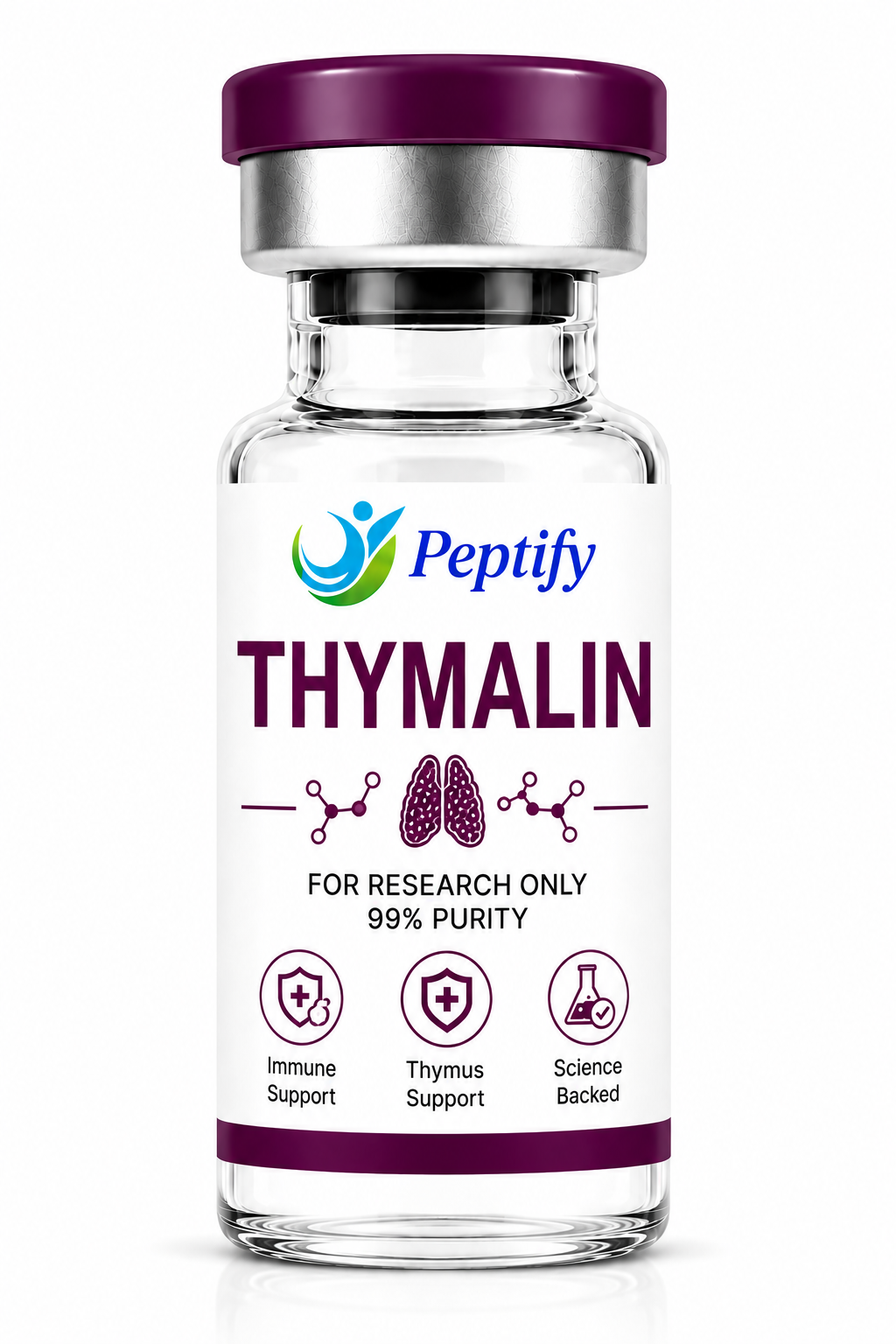
Thymalin 10mg
A thymic-peptide research entry for immune-aging literature context and safety review.
Contents
Use this guide as a structured review page. The same headings appear for every protocol so clients and the care team can scan the page consistently.
Protocol Overview
Thymalin is generally described as a thymus-derived peptide preparation used in immune and aging-biology research, distinct from single-sequence peptides such as thymosin alpha-1. Because composition, regulatory status, and evidence quality can vary by product, protocol review should emphasize identity verification, immune history, concomitant therapies, and clinician-led monitoring.
- Thymic-peptide research context
- Immune-aging literature review
- Product quality verification
- Clinician-guided safety discussion
Recommended Source
This protocol is linked to the workbook reference source below.
- Thymalin Dosage Guide: Immune Protocols | PeptideWiki Open source
Important Note
This page is informational and does not authorize use. Peptify clients should complete assessment, disclose medications and health history, and follow the clinician-approved plan only.
- Do not start, stop, combine, or change a protocol based only on website content.
- Emergency symptoms require urgent medical care, not a website or routine follow-up message.
How This Works
Thymalin is a synthetic dipeptide (L-glutamyl-L-tryptophan, or Glu-Trp) developed by Professor Vladimir Khavinson at the St. Petersburg Institute of Bioregulation and Gerontology in Russia. It belongs to the Khavinson family of peptide bioregulators — a class of short peptides designed to restore function to specific organs by modulating gene expression. Thymalin is the thymus-targeted bioregulator, alongside Epitalon (pineal gland), Cortagen (adrenal cortex), and Pinealon (central nervous system).
- Thymalin was originally derived from thymus gland extracts and represents the minimal active sequence of thymic peptides — the smallest fragment that retains the ability to modulate thymic function. The thymus gland is a critical organ of the immune system responsible for T-cell maturation and differentiation. However, the thymus naturally involutes (shrinks and is replaced by fatty tissue) starting around puberty. By age 60–70, thymic output of new T-cells is dramatically reduced, contributing to immunosenescence — the age-related decline in immune function that increases susceptibility to infections, cancer, and autoimmune disorders.
- Thymalin's research focus is on reversing this age-related thymic decline. Khavinson's clinical studies, conducted over decades primarily in elderly populations, reported that short courses of Thymalin improved T-cell counts, CD4/CD8 ratios, natural killer cell activity, and overall immune competence. Longer-term follow-ups (6–8 years) in some studies reported reduced infection rates and improved survival in elderly cohorts receiving periodic Thymalin courses.
- Use our Peptide Dosage to calculate your exact dose based on vial size and concentration.
- Synthetic dipeptide bioregulator (Glu-Trp) — L-glutamyl-L-tryptophan; the minimal active sequence derived from thymus gland extracts; only 2 amino acids
- Thymic function restoration — modulates gene expression in thymic tissue to restore T-cell differentiation, maturation, and output — targeting the root cause of immunosenescence
- Khavinson bioregulator family — part of the peptide bioregulator system alongside Epitalon (pineal), Cortagen (adrenal), and Pinealon (CNS) — each targeting a specific organ
- Short-course protocol — administered as 5–10 day courses repeated every 6 months; designed to reset thymic function rather than provide continuous stimulation
- Immune restoration in elderly populations — Khavinson’s clinical studies reported improved T-cell counts, CD4/CD8 ratios, NK cell activity, reduced infection rates, and improved longevity in elderly subjects
- Very well-tolerated safety profile — no significant adverse effects reported in clinical studies, including in elderly and frail populations; potential concern in autoimmune patients
- For a complete overview of thymic peptides and immune modulation, see our Thymosin Alpha-1 profile. New to peptides? Start with the Beginner's Guide to Peptides.
Dosing & Reconstitution Guide
Thymalin dosing is derived directly from the Khavinson clinical protocols developed at the St. Petersburg Institute of Bioregulation and Gerontology. Unlike many research peptides where community experience drives dosing evolution, Thymalin's protocol has remained remarkably consistent since its clinical introduction — reflecting the bioregulator philosophy that a specific short-course dosage triggers lasting epigenetic changes in the target organ.
| Bac Water Added | Concentration | 5 mg Dose | 10 mg Dose |
|---|---|---|---|
| 0.5 mL | 20 mg/mL | 25 units (0.25 mL) | 50 units (0.5 mL) |
| 1 mL | 10 mg/mL | 50 units (0.5 mL) | 100 units (1 mL) |
| 2 mL | 5 mg/mL | 100 units (1 mL) | Full vial |
- Professor Vladimir Khavinson conducted multiple clinical studies spanning decades, primarily in elderly populations (60–80+ years old) in Russia. These studies used a standardized protocol of 10 mg Thymalin administered intramuscularly once daily for 5–10 consecutive days, with courses repeated every 6–12 months. Subjects were monitored with immune panel bloodwork including T-cell subsets (CD3, CD4, CD8), CD4/CD8 ratios, natural killer cell counts, and immunoglobulin levels. Results consistently showed improvements in these markers following Thymalin courses, with effects persisting for months between courses.
- The dosing logic for Thymalin (and all Khavinson bioregulators) is rooted in the theory that short peptide sequences can interact with specific DNA regions and modulate gene expression in the target tissue. According to this model, a brief exposure (5–10 days) is sufficient to initiate a cascade of gene-expression changes that persist well beyond the administration period. This explains why Thymalin is not used continuously like most Western research peptides — the short course is the therapeutically active unit, not the individual daily dose.
- Khavinson's most cited long-term studies followed elderly cohorts for 6–8 years, comparing those receiving periodic Thymalin (and/or Epitalon) courses against controls. The treatment groups showed reduced mortality rates, lower infection frequency, improved cardiovascular markers, and better overall functional status. While these results are striking, they come from studies published primarily in Russian journals and have not been independently replicated in large Western randomized controlled trials.
- Community practitioners have largely adopted the Khavinson protocol without major modifications. The primary community refinement has been the use of subcutaneous injection instead of intramuscular, at the same 5–10 mg dose, for ease of self-administration. Some practitioners use the lower end (5 mg) for maintenance courses and the higher end (10 mg) for initial or more aggressive immune restoration. A small number of practitioners have experimented with sublingual administration, but this remains highly experimental with limited data.
- Scroll for more columns →
- Enter your vial size, water volume, and desired dose — get instant calculations with zero manual math.
Dosing Protocol
Thymalin dosing follows the Khavinson bioregulator model: short intensive courses rather than continuous daily use. The protocol is straightforward — a fixed daily dose for a defined number of days, repeated at regular intervals. This is fundamentally different from the titration-based, continuous dosing used for most Western research peptides.
| Protocol | Course Length | Interval Between Courses | Notes |
|---|---|---|---|
| Standard Khavinson | 10 days | 6 months | The gold standard protocol from clinical studies; most commonly used |
| Abbreviated | 5 days | 6 months | Shorter course; may be sufficient for maintenance in younger individuals |
| Accelerated | 10 days | 3–4 months | More frequent courses; used by some for significant immune compromise |
| Long-Term Maintenance | 5–10 days | 6–12 months, ongoing | Indefinite periodic courses; the Khavinson longevity protocol approach |
- Scroll for more columns →
- Dose: 5–10 mg dissolved under the tongue, held for 60–90 seconds before swallowing
- Frequency: 1x daily for 10–20 days
- Status: Highly experimental with very limited data; some practitioners report using this route, but bioavailability is uncertain
- Note: As a dipeptide, Thymalin's small size may allow some sublingual mucosal absorption, but this has not been validated in clinical studies
- These vendors are vetted by PeptideWiki for purity testing and COA transparency.
- Thymalin was originally developed for intramuscular injection, which was the standard route in Khavinson's clinical research. However, community use has expanded to include subcutaneous injection and experimental sublingual administration. Each route has trade-offs in terms of absorption, convenience, and evidence base.
- Thymalin is supplied as a lyophilized (freeze-dried) powder, typically in 10 mg vials. You reconstitute it with bacteriostatic water, then draw your dose using an insulin syringe. The reconstitution math is straightforward given the simple dosing protocol.
- Vial size: 10 mg of Thymalin
- Bacteriostatic water added: 1 mL
- Concentration: 10 mg ÷ 1 mL = 10 mg per mL
- Target dose: 10 mg (full vial = one dose)
- Volume to draw: 10 ÷ 10 = 1 mL = 100 units on an insulin syringe
- While Thymalin's dosing protocol is relatively uniform (short courses of 5–10 mg daily), the context and stacking approach varies by the primary goal. The same core protocol applies across use cases, but complementary peptides and monitoring strategies differ.
- The primary and most studied use case for Thymalin. Targets age-related thymic involution and the resulting decline in T-cell production, immune surveillance, and overall immune competence. This is the protocol with the strongest clinical evidence from Khavinson's long-term studies.
- Dose: 10 mg daily (IM or SubQ)
- Course: 10 days, repeated every 6 months
- Monitoring: Immune panel bloodwork (CBC, T-cell subsets, NK cells) before and 4–8 weeks after each course
- Stack: + Epitalon 10 mg daily for 10 days (pineal + thymic bioregulation for comprehensive anti-aging)
- Following significant infections (viral, bacterial), the immune system can remain suppressed or dysregulated. A Thymalin course may help restore T-cell function and immune balance during the recovery phase, supporting the return to baseline immune competence.
- Course: 5–10 days, starting after the acute infection resolves
- Timing: Begin after acute symptoms have resolved — not during active infection (NF-κB signaling is needed for pathogen clearance)
- Stack: + Thymosin Alpha-1 1.6 mg 2–3x/week for direct T-cell stimulation alongside thymic restoration
- Combines Thymalin with other Khavinson bioregulators to address multiple organ systems involved in aging simultaneously. This is the most comprehensive application of the bioregulator philosophy — restoring function across the thymus, pineal gland, adrenal cortex, and nervous system in parallel.
- Thymalin: 10 mg daily for 10 days (thymic / immune)
- Epitalon: 10 mg daily for 10 days (pineal / melatonin / telomerase)
- Cortagen: 10 mg daily for 10 days (adrenal / stress response)
- Repeat: Entire protocol every 6 months
- Note: Bioregulators can be administered concurrently (same course period) or sequentially (one after another)
- Some practitioners use Thymalin as an adjunct to support immune surveillance capacity, particularly in individuals with a history of cancer or elevated cancer risk. The rationale is that restoring T-cell and NK cell function may improve the immune system's ability to detect and destroy abnormal cells. This application should only be pursued under direct medical supervision.
- Medical supervision: Required — do not self-treat cancer or cancer risk with research peptides
- Stack: + Thymosin Alpha-1 under physician guidance for enhanced immune surveillance
- Thymalin's cycling protocol is intrinsic to its design as a bioregulator peptide. Unlike continuous-use peptides (BPC-157, GHRPs) where cycling is a community-imposed best practice, the short-course structure IS the Thymalin protocol — it is how the peptide was used in clinical research from the beginning. The off-period is not a break; it is the period during which the bioregulatory changes initiated by the course take effect and persist.
- Shorten interval to 3–4 months if post-course bloodwork shows immune markers returning to baseline earlier than expected, or if the individual has significant immune compromise requiring more aggressive restoration.
- Extend interval to 12 months if immune markers remain improved at the 6-month check, indicating the bioregulatory effect is persisting longer than typical. This is more common in younger individuals with less advanced thymic involution.
- Standard 6-month interval is appropriate for most users and should be the default unless bloodwork indicates otherwise.
- Indefinite continuation of periodic courses is the intended long-term approach. Khavinson's longevity studies followed patients through multiple course cycles over 6–8+ years.
Lifestyle Factors
Thymalin stacks naturally with other bioregulator peptides (targeting different organ systems) and with immune-modulating peptides that work through complementary mechanisms. The stacking approach reflects the bioregulator philosophy of addressing multiple aspects of aging or immune dysfunction simultaneously.
| Compound | Dose | Route | Purpose |
|---|---|---|---|
| Thymalin | 10 mg daily for 10 days | IM or SubQ | Thymic restoration; immune system recovery |
| BPC-157 | 250–500 mcg, 1–2x daily | SubQ or Oral | Angiogenesis; growth factor upregulation; tissue repair |
- The flagship Khavinson bioregulator combination and the most studied multi-peptide longevity protocol. Thymalin restores thymic function and immune competence, while Epitalon targets the pineal gland to restore melatonin production and activate telomerase. Together, they address two of the most significant pillars of age-related decline: immune deterioration and neuroendocrine dysfunction. This combination was used in Khavinson's longest-running longevity studies.
- Scroll for more columns →
- Combines Thymalin's thymic organ restoration (upstream — improving the factory that produces T-cells) with Thymosin Alpha-1's direct immune cell activation (downstream — stimulating existing immune cells to function more effectively). This is the most comprehensive thymic immune stack available.
- Pairs the thymic bioregulator with the adrenal bioregulator for individuals dealing with both immune decline and chronic stress / adrenal dysfunction. Thymalin restores thymic function while Cortagen normalizes adrenal cortex function and cortisol regulation. Chronic stress is a known contributor to immune suppression, making this combination particularly relevant for stressed individuals with compromised immunity.
- Combines immune restoration with systemic tissue repair support. Thymalin restores thymic function and T-cell output, while BPC-157 promotes angiogenesis, growth factor upregulation, and tissue healing. This stack is particularly relevant for individuals recovering from illness or surgery where both immune function and tissue repair are compromised.
- Explore more combinations with our Peptide Stack Builder or browse the Top 10 Peptide Stacks guide.
Potential Benefits & Side Effects
Very rare and mild:
- Injection site reactions (IM or SubQ) — minor redness, soreness, or swelling at the injection site; standard for any injectable peptide and typically resolves within hours
- Mild fatigue or malaise during the first 1–2 days — reported occasionally, possibly related to immune system activation; self-resolving
- Low-grade temperature elevation — rare; may indicate immune activation response; typically transient
- Mild allergic reaction — extremely rare; discontinue immediately if rash, hives, or swelling occur
- NOT associated with Thymalin:
- No hormonal disruption (does not affect sex hormones, cortisol, or growth hormone axes)
- No tanning, skin pigmentation, or sexual side effects
- No appetite changes or metabolic effects
- No water retention or bloating
- No receptor desensitization or tolerance (bioregulatory mechanism)
- No known drug interactions in published literature (though always inform your healthcare provider of all supplements and peptides)
- Autoimmune diseases — Thymalin enhances immune function and T-cell activity. In autoimmune conditions (rheumatoid arthritis, lupus, multiple sclerosis, Hashimoto's thyroiditis, type 1 diabetes, etc.), the immune system attacks self-tissues. Enhancing immune function could theoretically worsen autoimmune activity. Use only under direct medical supervision if autoimmune conditions are present.
- Organ transplant recipients on immunosuppressants — enhancing immune function could counteract immunosuppressive medications and increase rejection risk. Absolutely contraindicated without transplant physician approval.
- Pregnancy and breastfeeding — no safety data exists for Thymalin during pregnancy or nursing. Avoid entirely.
- Active severe infections — while Thymalin supports immune recovery, starting a course during an acute severe infection may not be appropriate. Wait until the acute phase resolves before beginning a course.
- Known hypersensitivity — discontinue immediately if allergic reactions occur (rash, hives, difficulty breathing, swelling).
- Any signs of allergic reaction (rash, hives, facial swelling, difficulty breathing) — seek immediate medical attention
- Persistent fever above 38.5°C (101.3°F) during the course — this may indicate an underlying infection rather than a normal immune activation response
- Worsening of any autoimmune symptoms if using Thymalin with a known autoimmune condition
- Unusual fatigue, joint pain, or skin changes that develop during or shortly after a course
- Any symptom that feels unusual or concerning — err on the side of caution with any research peptide
- Avoid these common errors to get the most out of your Thymalin protocol:
Quickstart Highlights
This article is for educational and informational purposes only. See our Disclaimer.
- Thymalin (Glu-Trp) is a synthetic dipeptide bioregulator targeting the thymus — developed by Vladimir Khavinson to restore thymic function and reverse age-related immune decline (immunosenescence)
- Short-course protocol, not continuous use: 10 mg daily (IM or SubQ) for 5–10 days, repeated every 6 months — this is the standard Khavinson clinical protocol
- Part of the Khavinson bioregulator family — alongside Epitalon (pineal), Cortagen (adrenal), and Pinealon (CNS); each targets a different organ
- Not the same as Thymosin Alpha-1 — Thymalin restores thymic organ function (upstream), while Thymosin Alpha-1 directly stimulates immune cells (downstream); they can be stacked for complementary effects
- Gold standard stack: Thymalin + Epitalon for comprehensive anti-aging (thymic + pineal bioregulation) — the combination used in Khavinson's longevity studies
- Get bloodwork: Immune panel (CBC, T-cell subsets, NK cells) before and 4–8 weeks after each course to objectively track immune restoration
- Very well-tolerated — no significant adverse effects in clinical studies, including in elderly populations; rare injection site reactions only
- Caution in autoimmune conditions — enhancing immune function could theoretically worsen autoimmune activity; use only under medical supervision if autoimmune disease is present
- SubQ is the most popular community route — same dose as the original IM protocol, easier to self-administer, with comparable reported results
- Evidence primarily from Russian clinical literature — peer-reviewed and spanning decades, but not independently replicated in large Western RCTs. Approach with appropriate scientific rigor.
References
Continue your research with these resources.
- Thymalin Dosage Guide: Immune Protocols | PeptideWiki Open source
- Khavinson VKh, Morozov VG. “Peptides of pineal gland and thymus prolong human life.” Neuro Endocrinol Lett. 2003;24(3-4):233-240. PubMed Open source
- Khavinson VKh. “Peptide bioregulation of ageing.” Biogerontology. 2002;3(Suppl 1):36.
- Anisimov VN, Khavinson VKh. “Peptide bioregulation of aging: results and prospects.” Biogerontology. 2010;11(2):139-149. PubMed Open source
- Khavinson VKh, Malinin VV. “Gerontological aspects of genome peptide regulation.” Karger. 2005.
- Kuznik BI, et al. “Bioregulating peptides and the immune system: current state of the problem and prospective studies.” Adv Gerontol. 2017;30(6):836-847.
- Khavinson VKh, et al. “Effects of Livagen peptide on chromatin activation in lymphocytes in elderly people.” Bull Exp Biol Med. 2002;134(4):389-392. PubMed Open source
- Anisimov VN, et al. “Effect of Epitalon on biomarkers of aging, life span and spontaneous tumor incidence in female Swiss-derived SHR mice.” Biogerontology. 2003;4(4):193-202. PubMed Open source
- Morozov VG, Khavinson VKh. “Natural and synthetic thymic peptides as therapeutics for immune dysfunction.” Int J Immunopharmacol. 1997;19(9-10):501-505. PubMed Open source
- Khavinson VKh, et al. “Mechanism of biological activity of short peptides: cell penetration and epigenetic regulation of gene expression.” Biology Bulletin Reviews. 2013;3(6):451-455.
- Learn dosing protocols for Epitalon — the pineal bioregulator and Thymalin’s most popular stacking partner in Khavinson longevity protocols.
- Calculate your exact Thymalin dose based on vial size and reconstitution volume.
- Browse all peptides with research summaries and dosing data.
- Take the complete Thymalin (Glu-Trp) Dosage Guide with you. All sections, dosing tables, and FAQ — formatted for easy reference.
- Free. No spam. Unsubscribe anytime.
- Community-driven knowledge base for research peptides. Evidence-based profiles, dosing guides, and practical tools.
- Peptide Directory
- Browse by Goal
- Peptide Glossary
- Guides
- Stack Guides
- Deals
- Dosage Calculator
- Stack Builder
- Peptide Quiz
- Protocol Tracker
- Cheat Sheet
- Blog
- News & Media
- Scientific Research
- Community
- About PeptideWiki
- Editorial Standards
- Community Guidelines
- Affiliate Disclosure