
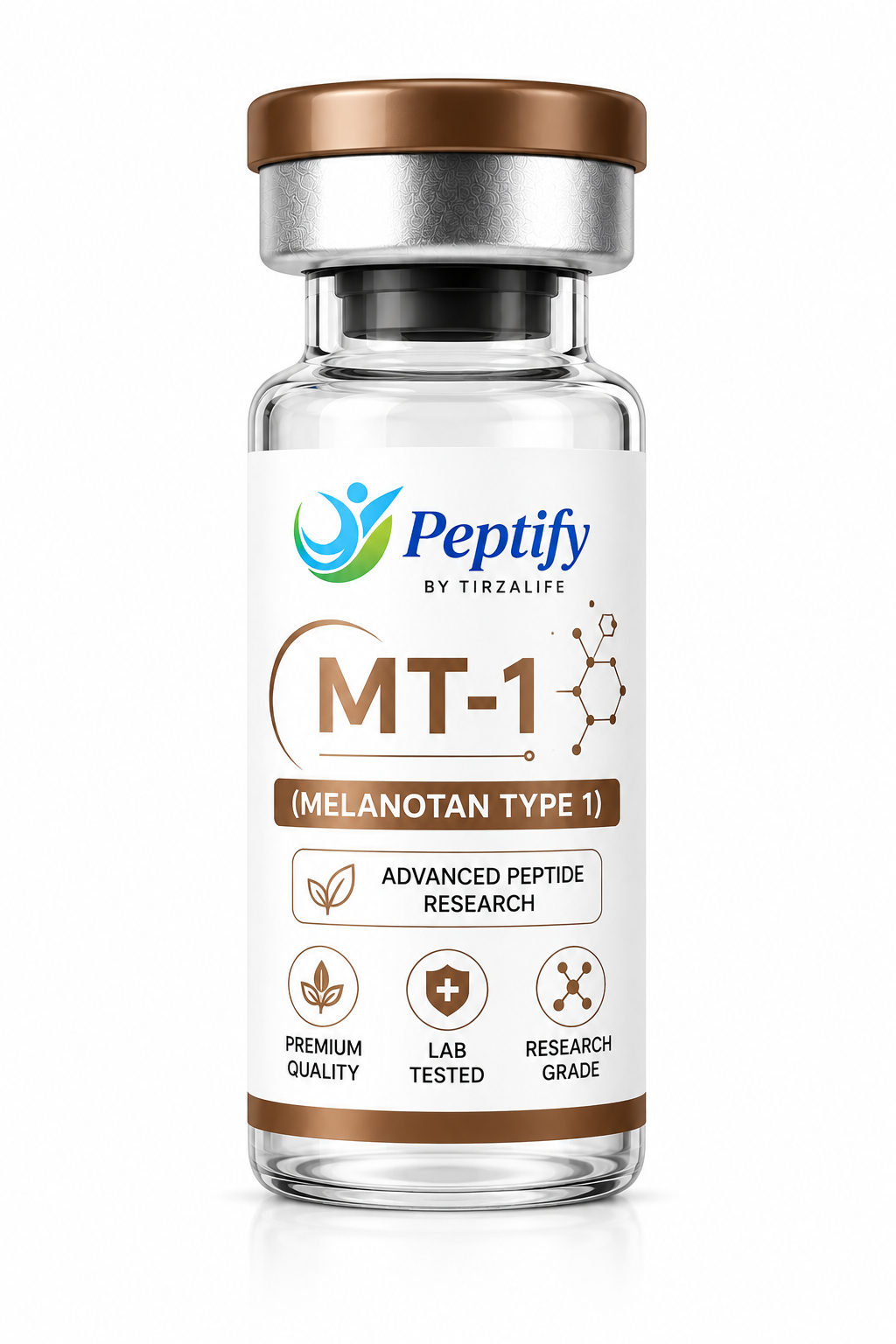
MT-1 (Melanotan Receptor Type 1) 10mg
A melanocortin research entry focused on skin-pigment biology, product verification, and safety review.
Contents
Use this guide as a structured review page. The same headings appear for every protocol so clients and the care team can scan the page consistently.
Protocol Overview
MT-1 is a melanotan I or afamelanotide-related alpha-MSH analog that acts through melanocortin pathways involved in melanin production and skin photobiology. FDA-approved afamelanotide exists as a controlled implant for erythropoietic protoporphyria, but this vial is a separate research product; any review should emphasize identity verification, dermatologic history, mole and skin monitoring, and avoidance of cosmetic tanning claims.
- Melanocortin pathway research context
- Dermatologic safety screening
- Skin and mole monitoring discussion
- Clinician-guided eligibility review
Recommended Source
This protocol is linked to the workbook reference source below.
- Melanotan I Dosage Guide: Protocols & Safety | PeptideWiki Open source
Important Note
This page is informational and does not authorize use. Peptify clients should complete assessment, disclose medications and health history, and follow the clinician-approved plan only.
- Do not start, stop, combine, or change a protocol based only on website content.
- Emergency symptoms require urgent medical care, not a website or routine follow-up message.
How This Works
Melanotan I (afamelanotide, CUV1647) is a synthetic linear tridecapeptide analog of alpha-melanocyte-stimulating hormone (α-MSH). It is a selective MC1R agonist — meaning it primarily activates the melanocortin-1 receptor (MC1R) responsible for melanogenesis, with minimal activity at MC3R, MC4R, and MC5R. This selectivity gives it a significantly cleaner pharmacological profile compared to the non-selective Melanotan II.
- The MC1R receptor is expressed on melanocytes in the skin. When activated by Melanotan I, melanocytes increase production of eumelanin — the dark, photoprotective pigment that absorbs UV radiation and scavenges free radicals. This is fundamentally different from pheomelanin (the reddish-yellow pigment that generates free radicals when exposed to UV). By shifting the melanin ratio toward eumelanin, Melanotan I provides genuine photoprotection beyond mere cosmetic darkening.
- Afamelanotide is notable for being one of very few melanocortin peptides with genuine pharmaceutical approval. The FDA approved Scenesse (afamelanotide 16 mg implant) in 2019 for the treatment of erythropoietic protoporphyria (EPP) — a rare genetic condition causing extreme photosensitivity and severe pain upon sunlight exposure. The European Medicines Agency (EMA) approved it in 2014.
- Use our Peptide Dosage to calculate your exact dose based on vial size and concentration.
- Selective MC1R agonist — primarily activates the melanocortin-1 receptor responsible for eumelanin production, with minimal activity at MC3R, MC4R, and MC5R
- Linear tridecapeptide — 13 amino acid analog of α-MSH with improved metabolic stability and MC1R selectivity
- FDA-approved (Scenesse) — 16 mg subcutaneous implant approved in 2019 for erythropoietic protoporphyria (EPP) — one of very few approved melanocortin therapeutics
- Photoprotective mechanism — stimulates eumelanin (dark, protective pigment) that absorbs UV and scavenges free radicals — genuine biological sun protection
- Clean side effect profile — no sexual side effects, no appetite changes, significantly less nausea compared to Melanotan II
- Half-life ~30 minutes (injection) — but melanogenesis effects persist for days to weeks as eumelanin production and accumulation is an ongoing biological process
- For a comparison with the non-selective melanocortin agonist, see our Melanotan II profile and dosage guide. For the related sexual function peptide derived from MT-II research, see PT-141. New to peptides? Start with the Beginner's Guide to Peptides.
Dosing & Reconstitution Guide
Melanotan I dosing benefits from an unusual advantage among research peptides: it has genuine pharmaceutical development data from the Scenesse clinical trials. These phase II and phase III studies established efficacy, pharmacokinetics, and safety in EPP patients. Research dosing protocols are derived from a combination of clinical trial data, pharmacokinetic studies, and community experience.
| Bac Water Added | Concentration | 0.5 mg Dose | 1 mg Dose |
|---|---|---|---|
| 1 mL | 10 mg/mL | 5 units (0.05 mL) | 10 units (0.1 mL) |
| 2 mL | 5 mg/mL | 10 units (0.1 mL) | 20 units (0.2 mL) |
| 2.5 mL | 4 mg/mL | 12.5 units (0.125 mL) | 25 units (0.25 mL) |
| 5 mL | 2 mg/mL | 25 units (0.25 mL) | 50 units (0.5 mL) |
- The Scenesse implant delivers 16 mg of afamelanotide over approximately 60 days via a bioabsorbable subcutaneous implant. Clinical trials demonstrated significant increases in melanin density, increased pain-free time in sunlight for EPP patients, and an acceptable safety profile. Peak plasma concentrations occur within hours of implant insertion, with sustained low-level release over the implant lifetime. This slow-release pharmacokinetic profile differs fundamentally from injectable protocols.
- After subcutaneous injection, afamelanotide reaches peak plasma concentration within 1–2 hours and has an elimination half-life of approximately 30 minutes. However, the biological effect (eumelanin production) far outlasts the plasma presence because melanocytes continue synthesizing and depositing melanin after receptor activation. This disconnect between pharmacokinetic half-life and biological effect duration is why maintenance dosing every 2–3 days is sufficient despite the short plasma half-life.
- Unlike Melanotan II, which activates multiple melanocortin receptors at escalating doses, Melanotan I maintains MC1R selectivity across the clinically relevant dose range. This means increasing the dose does not progressively recruit MC3R, MC4R, or MC5R activity — you get more melanogenesis without gaining sexual, appetite, or other off-target effects. However, the melanogenic response has a practical ceiling: doses above 1 mg per injection do not produce proportionally faster or darker tanning but do increase nausea risk.
- Baseline melanin levels significantly influence the response to Melanotan I. Individuals with Fitzpatrick skin types I–II (very fair, always burns) generally require a full loading protocol and may take longer to develop visible tanning. Skin types III–IV (medium, tans easily) typically respond faster and may need lower maintenance doses. The EPP clinical trials included predominantly fair-skinned patients (types I–III) and demonstrated efficacy across these skin types.
- Enter your vial size, water volume, and desired dose — get instant calculations with zero manual math.
Dosing Protocol
Melanotan I is administered by subcutaneous injection for research use or as a subcutaneous implant (Scenesse) for pharmaceutical use. Research dosing follows a two-phase approach: a loading phase of daily injections to build baseline eumelanin levels, followed by a maintenance phase of less frequent injections to preserve the tan.
| Phase | Protocol | Duration | Notes |
|---|---|---|---|
| Pre-Season Loading | 0.5–1 mg daily (SubQ) | 10–20 days | Start 2–3 weeks before sun exposure season to build baseline eumelanin |
| In-Season Maintenance | 0.5–1 mg every 2–3 days | 3–5 months | Maintain throughout summer/sun season; adjust frequency based on tan retention |
| Off-Season Break | No MT-I | 3–5 months | Tan fades naturally over 4–8 weeks as melanin-containing keratinocytes shed through normal skin turnover |
- Dose: 16 mg afamelanotide subcutaneous implant
- Frequency: Every 60 days (administered by healthcare provider)
- Indication: Erythropoietic protoporphyria (EPP) — FDA-approved
- Delivery: Bioabsorbable implant inserted above the iliac crest (hip area)
- Notes: Slow-release over ~60 days; provides consistent plasma levels unlike injectable peaks
- Time of day: Evening injections are preferred by most users, as mild nausea (if it occurs) can be slept through
- Relation to meals: Injecting on an empty stomach or 1–2 hours after a light meal reduces nausea risk
- Relation to UV exposure: Inject 2–4 hours before any planned sun exposure for optimal synergy, or the evening before
- Consistency: During loading, inject at approximately the same time each day to maintain steady melanocyte stimulation
- These vendors are vetted by PeptideWiki for purity testing and COA transparency.
- The two Melanotan peptides are frequently confused, but they are pharmacologically distinct. Understanding their differences is essential for choosing the right peptide for your goals and tolerance for side effects.
- Melanotan I is supplied as a lyophilized (freeze-dried) powder, typically in 10 mg vials. You reconstitute it with bacteriostatic water, then draw your dose using an insulin syringe. The concentration depends on how much water you add to the vial.
- Vial size: 10 mg (10,000 mcg) of Melanotan I
- Bacteriostatic water added: 2 mL
- Concentration: 10,000 mcg ÷ 2 mL = 5,000 mcg per mL (5 mg/mL)
- Target dose: 1 mg (1,000 mcg)
- Volume to draw: 1,000 ÷ 5,000 = 0.2 mL = 20 units on an insulin syringe
- Melanotan I's selective MC1R activation makes it applicable to several distinct goals. The optimal protocol varies depending on whether you are targeting cosmetic tanning, photoprotection, or managing a specific photosensitivity condition.
- The most common use case. Building a natural-looking, even tan through eumelanin stimulation without excessive UV exposure. MT-I produces a gradual, natural-appearing tan that develops over 1–3 weeks. Results are more subtle and natural than MT-II's faster but sometimes uneven tanning.
- Loading: 0.5–1 mg SubQ daily for 10–14 days
- Maintenance: 0.5–1 mg every 2–3 days
- UV exposure: 10–15 minutes of moderate sun exposure per day during loading to enhance melanocyte activation
- Duration: Maintain throughout desired tanning period (e.g., spring through autumn)
- For individuals with fair skin (Fitzpatrick types I–II) who burn easily and want to build a protective eumelanin base before seasonal sun exposure. Also relevant for individuals with polymorphous light eruption (PLE) or mild photosensitivity. MT-I's eumelanin production provides genuine biological UV protection beyond cosmetic darkening.
- Loading: 0.5 mg SubQ daily for 14–20 days (start 2–3 weeks before anticipated sun exposure season)
- Maintenance: 0.5 mg every 2–3 days throughout the season
- UV exposure: Gradually increase sun exposure as eumelanin builds; continue using sunscreen on vulnerable areas
- Note: MT-I does not replace sunscreen or protective clothing — it supplements existing sun safety practices
- EPP patients experience severe photosensitivity with pain upon sunlight exposure due to protoporphyrin IX accumulation in the skin. Afamelanotide (Scenesse) is the only FDA-approved treatment specifically for this condition. The implant provides sustained MC1R stimulation, increasing pain-free time in sunlight.
- Dose: 16 mg subcutaneous implant (Scenesse)
- Frequency: Every 60 days, administered by a healthcare provider
- Setting: Prescription only; administered in a clinical setting
- Note: This is the only FDA-approved use of afamelanotide. EPP patients should work with their hematologist or dermatologist for treatment
- Vitiligo involves loss of melanocytes in patches of skin. Research has explored whether MC1R stimulation with afamelanotide, combined with narrowband UVB phototherapy, can accelerate repigmentation. Early clinical trials showed promising results for combined afamelanotide + NB-UVB therapy compared to NB-UVB alone.
- Approach: Afamelanotide combined with narrowband UVB phototherapy
- Research dose: 16 mg implant (clinical trial protocol) or 0.5–1 mg SubQ daily (research protocols)
- Note: This is an active research area — afamelanotide is not currently approved for vitiligo. Consult a dermatologist
- Unlike GHRPs such as Hexarelin, Melanotan I does not cause receptor desensitization in the same manner. MC1R does not downregulate as aggressively as GHS-R1a. However, cycling is still recommended for practical and safety reasons: melanin accumulation has diminishing returns over time, and periodic breaks allow skin assessment and reduce cumulative exposure.
- The most practical approach for cosmetic tanning. Align MT-I use with sun exposure seasons and take breaks during winter or low-UV periods when maintaining a tan is less relevant.
- For users seeking year-round photoprotection or consistent skin tone. Uses the minimum effective dose during low-UV months to maintain some eumelanin protection without full-dose loading.
- High-UV months (spring/summer): Standard maintenance — 0.5–1 mg every 2–3 days
- Low-UV months (autumn/winter): Reduced maintenance — 0.5 mg once or twice per week
- Note: This is more appropriate for photoprotection goals than pure cosmetic tanning
- For users who want to build a tan for a specific event, vacation, or period of sun exposure. Run a focused loading phase, maintain through the event period, then discontinue.
- Loading: 0.5–1 mg daily for 14–20 days before the event
- During event: 0.5–1 mg every 2 days + moderate UV exposure
- Post-event: Discontinue; tan fades over 4–8 weeks
Lifestyle Factors
Melanotan I is primarily used as a standalone peptide for tanning and photoprotection. Unlike GHRPs or GHRHs, it does not have a natural “synergy partner” in the same mechanistic sense. However, it can be used alongside other peptides when pursuing multiple goals simultaneously.
| Compound | Dose | Frequency | Purpose |
|---|---|---|---|
| Melanotan I | 0.5–1 mg SubQ | Daily (loading) or every 2–3 days (maintenance) | MC1R — tanning, photoprotection |
| Ipamorelin | 200–300 mcg SubQ | 1–3x daily (fasted) | GHS-R1a — GH pulse trigger, clean GHRP |
| CJC-1295 (no-DAC) | 100 mcg SubQ | At each Ipamorelin injection | GHRH-R — amplifies and sustains GH pulse |
- Combines Melanotan I's eumelanin stimulation with GHK-Cu's collagen synthesis, wound healing, and antioxidant properties. This pairing supports both skin pigmentation and overall skin health — photoprotection from eumelanin plus structural skin repair and rejuvenation from the copper peptide.
- For users who want photoprotection and tanning alongside systemic tissue repair benefits. BPC-157 supports gut health, tendon and ligament healing, and anti-inflammatory activity through independent mechanisms that do not interact with MC1R signaling.
- A multi-goal protocol for users seeking tanning and photoprotection alongside growth hormone optimization for body composition, recovery, and anti-aging benefits. These peptides operate through entirely separate receptor systems (MC1R vs. GHS-R1a vs. GHRH-R) with no pharmacological interaction.
- Explore more combinations with our Peptide Stack Builder or browse the Top 10 Peptide Stacks guide.
Potential Benefits & Side Effects
Generally mild and dose-dependent:
- Nausea — the most common side effect, usually mild and less frequent/severe than with MT-II. Most common during the first few days of loading; often resolves with continued use
- Facial flushing — mild, transient warmth and redness of the face shortly after injection. Generally harmless and resolves within 30–60 minutes
- Headache — occasional, typically in the first few days. Usually resolves without intervention
- Fatigue or drowsiness — some users report mild tiredness after injection, which is why evening dosing is preferred
- Injection site reactions — minor redness, soreness, or itching at the injection site. Rotate injection sites to minimize
- Notable by absence (compared to Melanotan II):
- No sexual side effects — no spontaneous erections, no sexual arousal changes (MC4R is not significantly activated)
- No appetite suppression — no changes in hunger or food intake (MC4R is not significantly activated)
- Significantly less nausea — a major advantage over MT-II, which commonly causes moderate to severe nausea
- Because Melanotan I stimulates melanocyte activity, careful skin monitoring is essential:
- Darkening of existing moles — expected and common. Most existing moles will darken somewhat. This is generally benign but should be monitored
- New moles or freckles — may appear, particularly in sun-exposed areas. Document and monitor any new lesions
- Uneven tanning — areas with more melanocytes (face, arms, genitals) may darken more than other areas. This is a normal variation in melanocyte density
- IMPORTANT: Get a baseline dermatological examination before starting MT-I. Photograph all moles. Report any changes in size, shape, color, borders, or texture to a dermatologist promptly. While eumelanin production is photoprotective, increased melanocyte activity warrants professional monitoring
- Melanoma or history of melanoma — stimulating melanocyte activity in the presence of melanocytic neoplasia is contraindicated. Active melanoma, history of melanoma, or atypical mole syndrome are absolute contraindications
- Pregnancy and breastfeeding — no adequate safety data exists for afamelanotide during pregnancy or nursing. Avoid entirely
- Severe hepatic impairment — afamelanotide undergoes hepatic metabolism. Severe liver dysfunction may alter peptide clearance
- Other active skin cancers — increased melanocyte activity in the setting of active cutaneous malignancy is not recommended
- Known hypersensitivity — allergy to afamelanotide or any component of the formulation
- Addison's disease or other conditions with elevated α-MSH — additional MC1R stimulation may be inappropriate in conditions already characterized by excessive melanocortin signaling
- Any suspicious mole changes (asymmetry, border irregularity, color variation, diameter increase, evolving appearance) — stop and see a dermatologist immediately
- Persistent or worsening nausea beyond the first few days of loading
- Severe headache or prolonged facial flushing
- Any allergic reaction (rash, hives, swelling, difficulty breathing) — seek medical attention immediately
- Unexplained fatigue or malaise that persists beyond the initial loading phase
- Avoid these common errors to get the most out of your Melanotan I protocol:
Quickstart Highlights
This article is for educational and informational purposes only. See our Disclaimer.
- Melanotan I is a selective MC1R agonist — it stimulates eumelanin production for tanning and photoprotection without activating MC3R, MC4R, or MC5R
- Loading: 0.5–1 mg SubQ daily for 10–20 days — builds baseline eumelanin levels. Start at 0.5 mg to assess tolerance
- Maintenance: 0.5–1 mg every 2–3 days — preserves the tan by replenishing melanin as keratinocytes naturally shed
- FDA-approved as Scenesse — 16 mg implant every 60 days for erythropoietic protoporphyria (EPP). One of very few approved melanocortin peptides
- Much cleaner than Melanotan II — no sexual side effects, no appetite changes, significantly less nausea. MC1R selectivity eliminates the off-target effects of non-selective Melanotan II
- Eumelanin is genuinely photoprotective — it absorbs UV radiation and scavenges free radicals, providing biological sun protection beyond cosmetic darkening
- Mole monitoring is mandatory — get a baseline skin exam before starting, photograph moles, and report any changes to a dermatologist
- Moderate UV exposure enhances results — 10–15 minutes of sun synergizes with MC1R stimulation, but do not use aggressive tanning
- Seasonal cycling is practical — load before sun season, maintain through summer, break in winter. Use off-periods for skin assessment
- Do not exceed 1 mg per injection — higher doses increase nausea without proportionally faster tanning. The melanogenic response plateaus
- Store reconstituted peptide refrigerated (2–8°C) — use within 3–4 weeks. Always reconstitute with bacteriostatic water
References
Continue your research with these resources.
- Melanotan I Dosage Guide: Protocols & Safety | PeptideWiki Open source
- Langan EA, et al. “The role of melanocortin-1 receptor in skin biology and pathology.” Br J Dermatol. 2013;168(4):681-691.
- Fabrikant J, et al. “A review and update on melanocyte stimulating hormone therapy: afamelanotide.” J Drugs Dermatol. 2013;12(7):775-779. PubMed Open source
- Langendonk JG, et al. “Afamelanotide for erythropoietic protoporphyria.” N Engl J Med. 2015;373(1):48-59. PubMed Open source
- Biolcati G, et al. “Long-term observational study of afamelanotide in 115 patients with erythropoietic protoporphyria.” Br J Dermatol. 2015;172(6):1601-1612. PubMed Open source
- Minder EI, et al. “Pharmacokinetics and pharmacodynamics of afamelanotide and its clinical use in treating dermatologic disorders.” Clin Pharmacokinet. 2017;56(8):815-823. PubMed Open source
- Grimes PE, et al. “Afamelanotide and narrowband UV-B phototherapy for the treatment of vitiligo: a randomized multicenter trial.” JAMA Dermatol. 2013;149(1):68-73. PubMed Open source
- Haylett AK, et al. “The effect of afamelanotide on cutaneous melanin density and UV sensitivity in humans.” Pigment Cell Melanoma Res. 2011;24(5):914-917.
- Harms J, et al. “Afamelanotide: a review of the clinical development of an alpha-melanocyte-stimulating hormone analogue.” Expert Opin Investig Drugs. 2011;20(3):365-378.
- Beaumont KA, et al. “Receptor function, dominant negative activity and phenotype correlations for MC1R variant alleles.” Hum Mol Genet. 2007;16(18):2249-2260. PubMed Open source
- Compare protocols for the non-selective melanocortin agonist — tanning plus sexual and appetite effects.
- Calculate your exact Melanotan I dose based on vial size and reconstitution volume.
- Browse all peptides with research summaries and dosing data.
- Take the complete Melanotan I Dosage Guide with you. All 13 sections, dosing tables, and FAQ — formatted for easy reference.
- Free. No spam. Unsubscribe anytime.
- Community-driven knowledge base for research peptides. Evidence-based profiles, dosing guides, and practical tools.
- Peptide Directory
- Browse by Goal
- Peptide Glossary
- Guides
- Stack Guides
- Deals
- Dosage Calculator
- Stack Builder
- Peptide Quiz
- Protocol Tracker
- Cheat Sheet
- Blog
- News & Media
- Scientific Research
- Community
- About PeptideWiki
- Editorial Standards
- Community Guidelines
- Affiliate Disclosure