
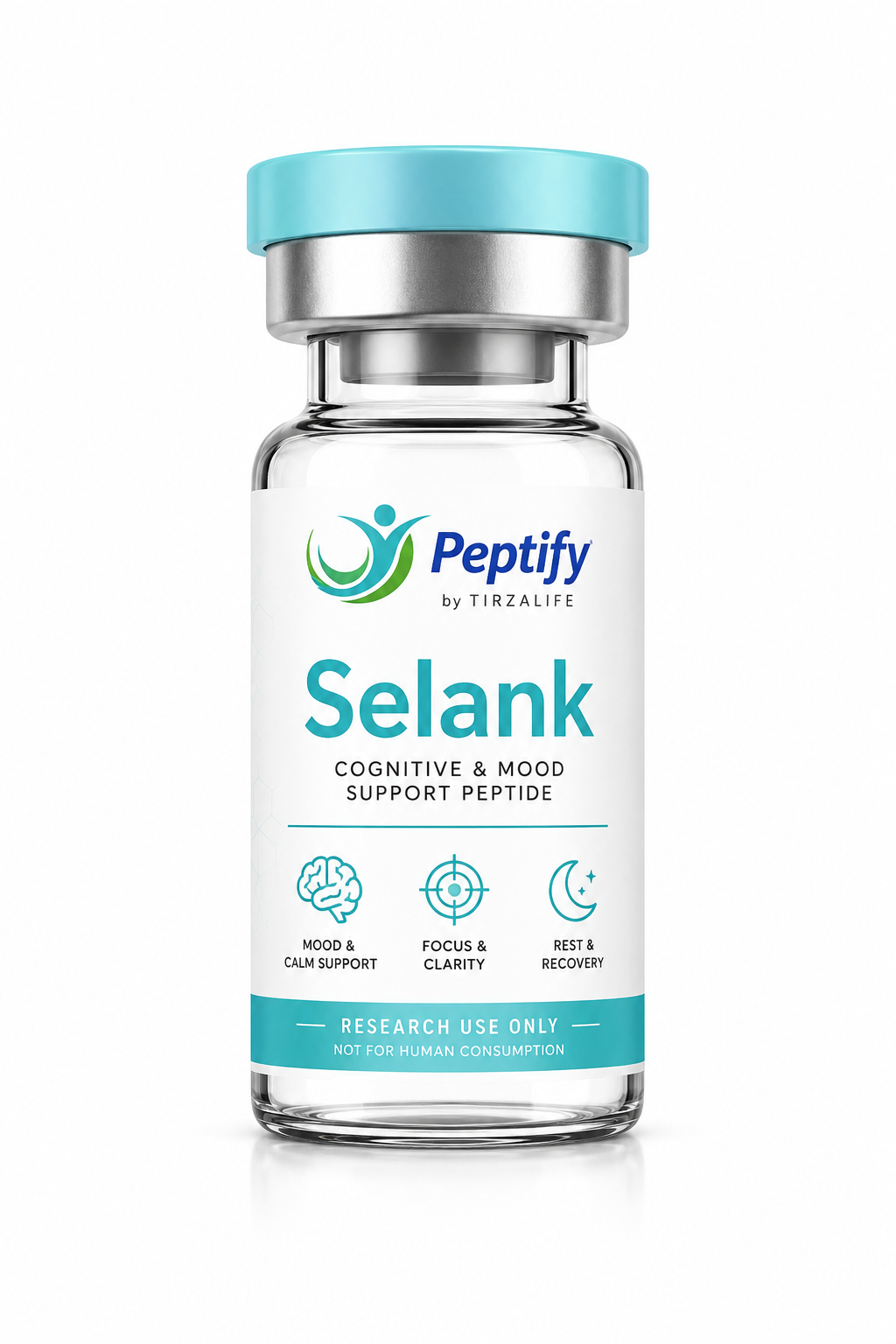
Selank 10mg
A research-use neuropeptide entry for stress-response literature context and safety review.
Contents
Use this guide as a structured review page. The same headings appear for every protocol so clients and the care team can scan the page consistently.
Important Note
This page is informational and does not authorize use. Peptify clients should complete assessment, disclose medications and health history, and follow the clinician-approved plan only.
- Do not start, stop, combine, or change a protocol based only on website content.
- Emergency symptoms require urgent medical care, not a website or routine follow-up message.
Dosing & Reconstitution Guide
A single practical dilution with accurate once-daily dosing, step by step
| Phase / Week(s) | Dose & Frequency | Volume (U-100 units / mL) |
|---|---|---|
| Weeks 1–2 | 300 mcg (1× daily) | ~9 units (0.09 mL) |
| Weeks 3–4 | 500 mcg (1× daily) | ~15 units (0.15 mL) |
- Reconstitute: Add 3.0 mL bacteriostatic water to one 10 mg vial → final concentration ~3.33 mg/mL (3,333 mcg/mL).
- Typical daily range: 300–500 mcg once daily, raised gradually over a 4-week cycle (often run 4 weeks on, 4 weeks off).
- Easy measuring: At ~3.33 mg/mL, 1 unit ≈ 33.3 mcg on a U-100 syringe; the typical 300–500 mcg dose reads at 9–15 units, comfortably within the precise range of U-100 markings.
- Storage: Lyophilized: store at −20 °C (−4 °F); after reconstitution, refrigerate at 2–8 °C (35.6–46.4 °F) and do not freeze the mixed solution.
Quickstart Highlights
Selank is a synthetic heptapeptide (the sequence Thr-Lys-Pro-Arg-Pro-Gly-Pro), an analog of the immunopeptide tuftsin, studied as an anxiolytic and nootropic agent[1][3]. This educational page outlines a once-daily subcutaneous approach with a dilution chosen so doses land on easy-to-read insulin-syringe marks. Note that the clinically validated, approved route is the intranasal spray (registered only in Russia/Ukraine); in the US, EU and UK Selank is not approved and is sold only as a research chemical — presented for research and educational use only.
- Add 3.0 mL bacteriostatic water to one 10 mg vial → ~3.33 mg/mL (3,333 mcg/mL), the largest practical dilution for accurate dosing.
- 300–500 mcg once daily, titrated upward gradually across a 4-week cycle (commonly run as 4 weeks on, 4 weeks off).
- At ~3.33 mg/mL, 1 unit ≈ 33.3 mcg; 300 mcg ≈ 9 units and 500 mcg ≈ 15 units on a U-100 syringe.
- Lyophilized: store at −20 °C (−4 °F); once reconstituted, refrigerate at 2–8 °C (35.6–46.4 °F) and do not freeze the solution.
- Important: Start with the Prep & Injection Guide — it covers the preparation and safety basics every protocol on this site assumes.
- Frequency: one subcutaneous injection each day, titrating up as tolerated. A common community pattern is a 4-week cycle (or 5 days on / 2 days off) followed by a break[3]. Note that the clinically studied, approved route for Selank is intranasal; subcutaneous injection is a research/community practice with weak pharmacologic rationale, since the peptide’s plasma half-life is only minutes[4]. These figures come from reference protocols, not from approved human dosing.
Reconstitution Steps
Draw 3.0 mL of bacteriostatic water into a sterile syringe.
- Release it slowly down the vial’s inner wall to limit foaming.
- Swirl or roll gently until fully dissolved — don’t shake.
- Label with the date and concentration, then refrigerate at 2–8 °C (35.6–46.4 °F), shielded from light.
- The 3.0 mL dilution is deliberately large so each daily dose reads at roughly 9–15 units, where U-100 syringe markings are most precise. Avoid freezing the reconstituted solution, since freeze–thaw can denature the peptide.
- Important: This guide is for educational purposes only and is not medical advice. For research use only. Not for human consumption.
Supplies Needed
Quantities below assume an 8–16 week course of once-daily injections with gradual titration.
- At 300–500 mcg per day a 10 mg vial lasts well over a week, but allowing for 4-week cycles and waste, plan for roughly one vial every 1–2 weeks.
- 8 weeks: ~5 vials
- 12 weeks: ~7 vials
- 16 weeks: ~10 vials
- Per injection: 1 syringe
- 8 weeks (once daily): ~56 syringes
- 16 weeks (once daily): ~112 syringes
- Use ~3.0 mL per 10 mg vial for reconstitution.
- 8 weeks (5 vials): ~15 mL → 2 bottles
- 16 weeks (10 vials): ~30 mL → 3 bottles
- One for the vial stopper + one for the injection site each day.
- Per injection: 2 swabs
- 8 weeks (once daily): ~112 swabs → 1–2 boxes
Protocol Overview
A concise summary of the once-daily regimen, drawn from commonly cited reference protocols.
- ▪Goal: Explore Selank’s reported anxiolytic and anti-asthenic (energy-supporting) effects — demonstrated mainly with the intranasal formulation in small Russian trials, where it was comparable to medazepam without sedation or dependence[1][2].
- ▪Schedule: Once-daily subcutaneous injections in 4-week cycles (commonly 4 weeks on, 4 weeks off), repeated as needed.
- ▪Dose Range: 300–500 mcg per day with gradual titration over the cycle.
- ▪Reconstitution: 3.0 mL bacteriostatic water per 10 mg vial gives ~3.33 mg/mL for accurate unit measurements.
- ▪Storage: Keep the dry vial frozen at −20 °C (−4 °F); once mixed, refrigerate at 2–8 °C and do not freeze the solution.
Dosing Protocol
A suggested daily titration approach based on common reference doses.
- ▪Start: Begin at 300 mcg once daily for the first two weeks to gauge tolerability.
- ▪Titrate: Increase to 500 mcg once daily from week 3 if the lower dose is well tolerated.
- ▪Target: Maintain around 500 mcg daily for the remainder of the 4-week cycle.
- ▪Cycle Length: Typically a 4-week cycle followed by a 4-week break; repeat as needed.
- ▪Timing: Inject at a consistent time each day and rotate injection sites systematically.
Storage Instructions
Correct storage is what preserves the peptide’s stability and activity.
- ▪Lyophilized: Hold the dry vial at −20 °C (−4 °F) in dry, dark conditions and limit moisture exposure[7].
- ▪Reconstituted: Refrigerate at 2–8 °C (35.6–46.4 °F) and use within about 28 days; do not freeze the mixed solution, as freezing can denature peptides[8].
- ▪Handling: Let frozen vials warm to room temperature before opening so condensation won’t form, and keep the solution clear of heat and direct light.
- ▪Freeze–thaw: Avoid repeated freeze–thaw cycles of the reconstituted solution.
Important Notes
Practical points that keep daily administration safe and consistent.
- ▪Sterile technique: Use a fresh sterile U-100 insulin syringe each time and drop it straight into a puncture-proof sharps container afterward.
- ▪Site rotation: Move between abdomen, thighs and upper arms to reduce local irritation and lipohypertrophy[9].
- ▪Slow injection: Push the plunger slowly and pause a few seconds before withdrawing the needle to prevent backflow.
- ▪Recordkeeping: Log the daily dose, injection site and any observations to keep the protocol consistent.
- ▪Regulatory note: Selank is an approved prescription nasal spray only in Russia and Ukraine; in the US, EU and UK it is not approved for human use and is sold strictly as a research chemical[6].
How This Works
Selank is a synthetic heptapeptide with the sequence Thr-Lys-Pro-Arg-Pro-Gly-Pro — an analog of the immunomodulatory peptide tuftsin, modified to resist rapid breakdown[1][3]. It was developed in Russia and is studied mainly as an anxiolytic (anti-anxiety) and anti-asthenic agent.
- Its proposed mechanism is unusual: Selank appears to modulate the expression of GABA-A receptor genes without binding the benzodiazepine site, which is offered as an explanation for anxiolytic activity that comes without sedation, tolerance, dependence or withdrawal[3]. It has also been reported to influence serotonin and other monoamines, to inhibit enkephalinase (slowing the breakdown of enkephalins), and in animal work to raise BDNF expression[5].
- The strongest human evidence is for the intranasal route: small Russian clinical trials in generalized anxiety and neurasthenia reported anxiolytic effects comparable to medazepam, but without the sedation or dependence typical of benzodiazepines[1][2]. Most cognitive, mood and BDNF findings come from animal studies and should be read as preliminary rather than established in humans.
- Important route caveat: the clinically validated and approved formulation is a ready-made intranasal spray. Subcutaneous injection, presented here, is a research/community practice with weak pharmacologic rationale — Selank’s plasma half-life is only minutes[4], so injected dosing has not been validated against the intranasal data.
- Approval status: Selank is an approved prescription drug (intranasal) only in Russia and Ukraine for anxiety/GAD. In the US, EU and UK it is not approved and is sold solely as a research chemical, presented here for research and educational purposes only.
Lifestyle Factors
Habits that may support mood, stress resilience and cognition alongside the protocol.
- ▪Nutrition: Eat adequate protein and omega-3 fats to supply the building blocks for neurotransmitter synthesis.
- ▪Activity: Regular aerobic and resistance exercise supports mood regulation and stress resilience.
- ▪Sleep: Aim for 7–9 hours of quality sleep to support neurological function and stress recovery.
- ▪Stress management: Use mindfulness, meditation or breathwork to complement Selank’s anxiolytic effects; minimize alcohol and stimulants.
Potential Benefits & Side Effects
What small human trials and preclinical studies describe; most human data uses the intranasal route, and individual results vary.
- ▪Anxiolytic (human, intranasal): Small Russian trials report anxiety reduction comparable to medazepam, without sedation or dependence[1][2].
- ▪Anti-asthenic (human): A 14-day intranasal course in neurasthenia was well tolerated and reported energy-supporting, anti-asthenic effects[2].
- ▪Nootropic signals (animal): Animal studies report effects on serotonin, monoamines and BDNF; cognitive/mood claims are largely preclinical and not established in humans[5].
- ▪Evidence limits: Human evidence is limited to small Russian trials using the intranasal spray; no large-scale or injection-route efficacy trials have been completed[3].
- ▪Injection-site reactions: Mild redness, tenderness or soreness can occur; rotating sites helps.
- ▪Unknown long-term profile: Human safety data is limited, so caution and monitoring are advised.
- ▪Stimulating effect: Some users report mild over-stimulation or difficulty sleeping if dosed late in the day; prefer morning administration.
Injection Technique
General subcutaneous technique, following established clinical best-practice guidance[10][11].
- ▪Wash your hands well with soap and water.
- ▪Wipe the vial stopper with an alcohol swab and let it air-dry.
- ▪Choose a site (abdomen, thigh, or upper arm) and clean it with a fresh alcohol swab, letting it dry fully[11].
- ▪Draw the intended dose, then check for air bubbles and push any out.
- ▪Pinch a skinfold at the chosen site between thumb and forefinger.
- ▪Insert the needle into the pinch at a 45–90-degree angle (use 45 degrees if the fat layer is thin)[10].
- ▪Skip aspiration for subcutaneous shots — it isn’t needed[10].
- ▪Press the plunger slowly and steadily until it’s fully down.
- ▪Wait 5–10 seconds, then pull the needle straight out to prevent leakage.
- ▪Drop the used syringe straight into a puncture-proof sharps container — never recap a needle.
- ▪Return the reconstituted vial to the fridge right away.
- ▪Rotate the injection site each day to prevent irritation and lipohypertrophy[9].
- ▪Watch the site for excess redness, swelling, or signs of infection.
Recommended Source
For high-purity research peptides, we point researchers to Prime Lab Peptides for Selank (10 mg).
- ▪Top-rated on Trustpilot: Independently reviewed as the highest-rated peptide lab on Trustpilot — making it the best current source in the USA. Open source
- ▪Third-party tested: Every batch ships with a Certificate of Analysis (COA) confirming purity and composition.
- ▪Consistent quality: ISO-aligned manufacturing and handling keep product integrity reliable batch to batch.
- ▪Cold-chain integrity: Temperature-controlled shipping and storage across the whole fulfilment chain.
- ▪Research-grade purity: Fit for educational and research use that demands high-quality peptides.
- Note: Product availability and specifications subject to change. Verify current product details on supplier website.
- Shop at Prime Lab Peptides →
References
Reference-derived details for Selank 10mg.
- Selank (10mg Vial) Dosage Protocol Open source
- 1 PubMed (Zozulya et al.) Efficacy and safety of intranasal Selank in generalized anxiety disorder — randomized human clinical trial. View Source ↗ Open source
- 2 PubMed (Medvedev et al.) Selank in neurasthenia: a 14-day intranasal course showing anxiolytic and anti-asthenic effects (human study). View Source ↗ Open source
- 3 Hindawi / BioMed Research International Review: intranasal Selank administration — neurobehavioral effects, pharmacology and clinical applications. View Source ↗ Open source
- 4 DrugBank / Pharmacology Selank pharmacokinetics: rapid plasma degradation (half-life on the order of minutes), relevant to route of administration. View Source ↗ Open source
- 5 PubMed (animal studies) Selank effects on serotonin/monoamine metabolism and BDNF expression in rodents (preclinical mechanism data). View Source ↗ Open source
- 6 Regulatory status Selank (Russian trade name) is a registered intranasal anxiolytic in Russia/Ukraine only; it is not approved in the US, EU or UK. View Source ↗ Open source
- 7 Peptide Storage Guide Best practices for storing lyophilized peptides (temperature, humidity and light protection). View Source ↗ Open source
- 8 Bacteriostatic Water Guidance Bacteriostatic water for injection: multi-dose vial stability and handling. View Source ↗ Open source
- 9 NCBI Bookshelf Best practices for subcutaneous injection: aseptic technique and site rotation. View Source ↗ Open source
- 10 Centers for Disease Control and Prevention (CDC) Subcutaneous injection technique: angle, site and no-aspiration guidance. View Source ↗ Open source
- 11 Subcutaneous Injection Technique (Patient Education) How to administer a subcutaneous injection: clinical technique guidelines. View Source ↗ Open source