
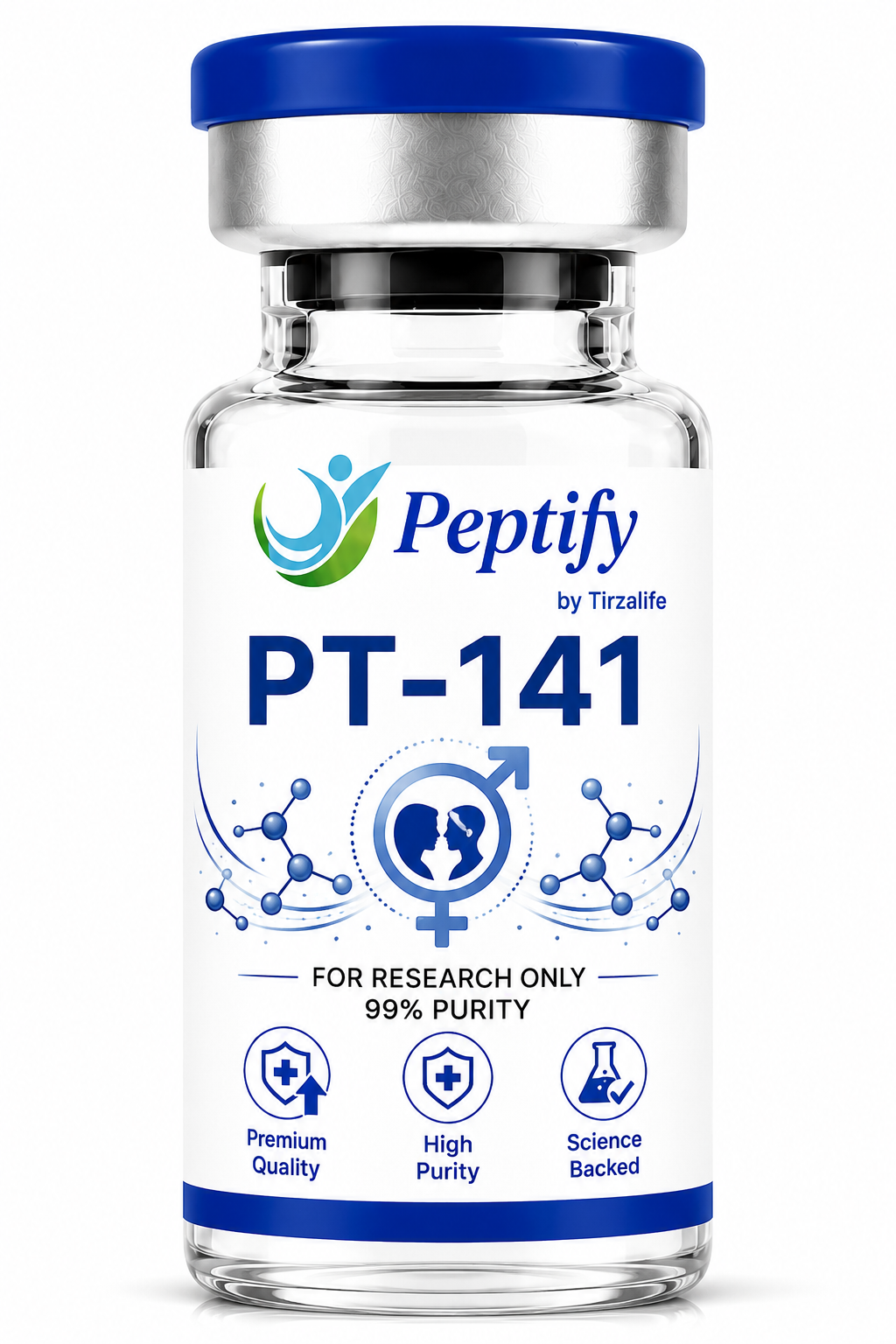
PT-141 10mg
A melanocortin research entry for product verification, cardiovascular screening, and clinician review.
Contents
Use this guide as a structured review page. The same headings appear for every protocol so clients and the care team can scan the page consistently.
Important Note
This page is informational and does not authorize use. Peptify clients should complete assessment, disclose medications and health history, and follow the clinician-approved plan only.
- Do not start, stop, combine, or change a protocol based only on website content.
- Emergency symptoms require urgent medical care, not a website or routine follow-up message.
Dosing & Reconstitution Guide
A single practical dilution with accurate as-needed dosing, step by step
| Dose | Timing | Volume (U-100 units / mL) |
|---|---|---|
| 1 mg (test / starting dose) | ~45 min before activity | 20 units (0.20 mL) |
| 1.5 mg (titrate if needed) | ~45 min before activity | 30 units (0.30 mL) |
| 2 mg (typical effective dose) | ~45 min before activity | 40 units (0.40 mL) |
- Reconstitute: Add 2.0 mL bacteriostatic water to one 10 mg vial → final concentration 5 mg/mL (5,000 mcg/mL).
- Typical dose: 1–2 mg as needed, taken roughly 45 minutes before anticipated activity. This is per-administration, not daily therapy.
- Easy measuring: At 5 mg/mL, 1 unit = 50 mcg on a U-100 syringe. So 1 mg reads at 20 units and 2 mg at 40 units — comfortable, easy-to-read volumes.
- Limits: Maximum one dose per 24 hours, and keep weekly use limited; exceeding labeled frequency raised the risk of focal skin hyperpigmentation in studies.
Quickstart Highlights
PT-141 (bremelanotide) is a melanocortin receptor agonist that acts on the central nervous system — predominantly through the MC4 receptor — to influence sexual desire and arousal[5][6]. Unlike PDE5 inhibitors that work on blood flow, it engages a brain pathway. Bremelanotide is FDA-approved as Vyleesi, but only for acquired, generalized hypoactive sexual desire disorder (HSDD) in premenopausal women[1]; any use for erectile dysfunction or libido in men is off-label / research only. This page outlines an as-needed (PRN) subcutaneous approach with a dilution chosen so doses land on easy-to-read insulin-syringe marks — presented for research and educational use only.
- Add 2.0 mL bacteriostatic water to one 10 mg vial → 5 mg/mL (5,000 mcg/mL), a clean dilution for accurate PRN dosing.
- 1–2 mg taken ~45 minutes before activity. Maximum one dose per 24 hours and limited per week — this is PRN, not a daily course.
- At 5 mg/mL, 1 unit = 50 mcg on a U-100 syringe; 1 mg = 20 units (0.20 mL) and 2 mg = 40 units (0.40 mL).
- Lyophilized: store at −20 °C (−4 °F); once reconstituted, refrigerate at 2–8 °C (35.6–46.4 °F) and do not freeze the solution.
- Important: Start with the Prep & Injection Guide — it covers the preparation and safety basics every protocol on this site assumes.
- Frequency: a single subcutaneous injection as needed, about 45 minutes before anticipated activity. Do not exceed one dose in 24 hours, and keep total use limited per week[1]. The FDA-approved Vyleesi regimen for HSDD in premenopausal women is a single 1.75 mg dose PRN; the figures here are practical research-reference measurements, not approved dosing for any other use.
Reconstitution Steps
Draw 2.0 mL of bacteriostatic water into a sterile syringe.
- Release it slowly down the vial’s inner wall to limit foaming.
- Swirl or roll gently until fully dissolved — don’t shake.
- Label with the date and concentration, then refrigerate at 2–8 °C (35.6–46.4 °F), shielded from light.
- The 2.0 mL dilution gives a clean 5 mg/mL so each milligram reads at exactly 20 units on a U-100 syringe. Avoid freezing the reconstituted solution, since freeze–thaw can denature the peptide.
- Important: This guide is for educational purposes only and is not medical advice. For research use only. Not for human consumption.
Supplies Needed
Quantities below assume as-needed (PRN) use over an 8–16 week window, with a 2 mg dose and the limit of one dose per 24 hours.
- At 5 mg/mL, one 10 mg vial provides about five 2 mg doses, so plan vials by how often you use it.
- ~16 doses: ~4 vials
- ~24 doses: ~5 vials
- ~32 doses: ~7 vials
- Per dose: 1 syringe
- ~16 doses: 16 syringes
- ~32 doses: 32 syringes
- Use ~2.0 mL per 10 mg vial for reconstitution.
- 4 vials: ~8 mL → 1 bottle
- 7 vials: ~14 mL → 2 bottles
- One for the vial stopper + one for the injection site per dose.
- Per dose: 2 swabs
- ~32 doses: ~64 swabs → 1 box
Protocol Overview
A concise summary of the as-needed regimen, drawn from labeling and commonly cited reference protocols.
- ▪Goal: Raise sexual desire and reduce related distress; FDA-approved (as Vyleesi) only for HSDD in premenopausal women, shown in two Phase 3 RECONNECT trials[2]. Note the satisfying-sexual-events endpoint was mixed.
- ▪Schedule: Subcutaneous, as needed — one dose ~45 minutes before activity; maximum one dose per 24 hours and limited per week[1].
- ▪Dose Range: 1–2 mg per administration; the approved Vyleesi dose is 1.75 mg PRN.
- ▪Reconstitution: 2.0 mL bacteriostatic water per 10 mg vial gives 5 mg/mL for accurate unit measurements.
- ▪Storage: Keep the dry vial frozen at −20 °C (−4 °F); once mixed, refrigerate at 2–8 °C and do not freeze the solution.
Dosing Protocol
A practical as-needed approach with clear limits.
- ▪Start: Try a conservative test dose (1 mg) to gauge tolerability before using a full dose.
- ▪Titrate: Move toward 1.5–2 mg based on response and tolerability.
- ▪Timing: Inject ~45–60 minutes before anticipated activity; individuals may adjust slightly based on personal response.
- ▪Do not exceed: one dose per 24 hours; keep weekly use limited — frequent dosing increased focal hyperpigmentation in studies.
- ▪Site: Subcutaneous in the abdomen or thigh; rotate sites between uses.
Storage Instructions
Correct storage is what preserves the peptide’s stability and activity.
- ▪Lyophilized: Hold the dry vial at −20 °C (−4 °F) in dry, dark conditions and limit moisture exposure[9].
- ▪Reconstituted: Refrigerate at 2–8 °C (35.6–46.4 °F) for short-term holding; do not freeze the mixed solution, as freezing can denature peptides[10].
- ▪Handling: Let frozen vials warm to room temperature before opening so condensation won’t form, and keep the solution clear of heat and direct light.
- ▪Freeze–thaw: Avoid repeated freeze–thaw cycles of the reconstituted solution.
Important Notes
Practical points that keep as-needed administration safe and consistent.
- ▪Sterile technique: Use a fresh sterile U-100 insulin syringe each time and drop it straight into a puncture-proof sharps container afterward[3].
- ▪Site rotation: Move between abdomen, thighs and upper arms to reduce local reactions and maintain absorption[3].
- ▪Cardiovascular caution: Bremelanotide causes transient increases in blood pressure and a small drop in heart rate; the label advises against use in people with uncontrolled hypertension or known cardiovascular disease[1].
- ▪Common side effects: Nausea (most frequent), flushing, headache, and injection-site reactions; nausea is usually worst with the first few doses[1].
- ▪Approval scope: FDA approval (Vyleesi) covers only HSDD in premenopausal women. Use for erectile dysfunction or libido in men is off-label / research and not an approved indication.
How This Works
PT-141 (bremelanotide) is a melanocortin receptor agonist that acts mainly through the MC4 receptor in the central nervous system[5][6]. It engages hypothalamic circuits tied to sexual desire and autonomic arousal — a brain pathway, fundamentally different from PDE5 inhibitors (such as sildenafil) that act on blood flow.
- In two Phase 3 RECONNECT trials in premenopausal women with HSDD, PRN 1.75 mg subcutaneous dosing improved validated measures of sexual desire and reduced desire-related distress versus placebo[2]. Honest framing matters here: the co-primary endpoint for satisfying sexual events was mixed, so the benefit is best described as a modest, real effect on desire and distress rather than a dramatic change.
- Because MC4R also participates in appetite and energy balance, exploratory work has examined whether melanocortin agonism affects caloric intake and body weight under intensive dosing[7]. That is mechanistic and early-stage — not an approved use.
- Important caveat: bremelanotide is FDA-approved — but the approval (Vyleesi) is specifically and only for acquired, generalized HSDD in premenopausal women. Use in men, for erectile dysfunction, or for general libido is off-label and investigational, and is presented here for research and educational purposes only.
- Subcutaneous delivery is standard for this molecule and supports practical at-home administration with small injection volumes[8].
Lifestyle Factors
Habits that may support outcomes alongside the protocol.
- ▪Timing & communication: Plan the ~45-minute lead time and align expectations with a partner so use matches anticipated activity.
- ▪Manage nausea: Since nausea is the most common effect, a light meal and unhurried timing can make the first few uses easier.
- ▪Overall well-being: Sleep, stress management and exercise support desire and general sexual health independent of any peptide.
- ▪Blood pressure awareness: Given the transient BP rise, avoid stacking with other agents that raise blood pressure and monitor if you are sensitive.
Potential Benefits & Side Effects
What the clinical evidence describes; effects are modest and individual results vary.
- ▪Sexual desire (Phase 3): Improved desire and reduced desire-related distress in premenopausal women with HSDD versus placebo[2].
- ▪Central mechanism: Works on a brain (MC4R) pathway rather than blood flow, so it targets desire/arousal directly[6].
- ▪Honest framing: The benefit is modest — the satisfying-sexual-events endpoint was mixed, so PT-141 is not a guaranteed or dramatic effect[2].
- ▪Off-label note: Reported use for libido/ED in men is not established or approved — that data is anecdotal and investigational.
- ▪Nausea, flushing, headache: The most common effects; nausea is frequent and usually worst with the first few doses[1].
- ▪Transient blood-pressure rise: A short-lived increase in blood pressure with a small heart-rate drop; relevant if you have cardiovascular risk[1].
- ▪Focal hyperpigmentation: Darkening of skin/gums can occur, and more frequent dosing than labeled increased this risk[1].
Injection Technique
General subcutaneous technique, following established clinical best-practice guidance[3][4].
- ▪Wash your hands well with soap and water.
- ▪Wipe the vial stopper with an alcohol swab and let it air-dry.
- ▪Choose a site (abdomen or thigh) and clean it with a fresh alcohol swab, letting it dry fully[4].
- ▪Draw the intended dose (e.g., 40 units for 2 mg), then check for air bubbles and push any out.
- ▪Pinch a skinfold at the chosen site between thumb and forefinger.
- ▪Insert the needle into the pinch at a 45–90-degree angle (use 45 degrees if the fat layer is thin)[3].
- ▪Skip aspiration for subcutaneous shots — it isn’t needed[3].
- ▪Press the plunger slowly and steadily until it’s fully down.
- ▪Wait 5–10 seconds, then pull the needle straight out to prevent leakage.
- ▪Drop the used syringe straight into a puncture-proof sharps container — never recap a needle.
- ▪Return the reconstituted vial to the fridge right away.
- ▪Rotate the injection site between uses to prevent irritation.
- ▪Watch the site for excess redness, swelling, or signs of infection.
Recommended Source
For high-purity research peptides, we point researchers to Prime Lab Peptides for PT-141 (10 mg).
- ▪Top-rated on Trustpilot: Independently reviewed as the highest-rated peptide lab on Trustpilot — making it the best current source in the USA. Open source
- ▪Third-party tested: Every batch ships with a Certificate of Analysis (COA) confirming purity and composition.
- ▪Consistent quality: ISO-aligned manufacturing and handling keep product integrity reliable batch to batch.
- ▪Cold-chain integrity: Temperature-controlled shipping and storage across the whole fulfilment chain.
- ▪Research-grade purity: Fit for educational and research use that demands high-quality peptides.
- Note: Product availability and specifications subject to change. Verify current product details on supplier website.
- Shop at Prime Lab Peptides →
References
Reference-derived details for PT-141 10mg.
- PT-141 (10mg Vial) Dosage Protocol Open source
- 1 FDA Prescribing Information — Vyleesi (bremelanotide) Official label: PRN 1.75 mg SC for HSDD in premenopausal women, dosing limits (max 1/24 h, 8/month), and precautions including transient blood-pressure increase and focal hyperpigmentation. View Source ↗ Open source
- 2 Obstetrics & Gynecology (2019) — RECONNECT trials Two Phase 3 randomized trials of bremelanotide 1.75 mg SC PRN for HSDD; improved desire and distress, with a mixed satisfying-sexual-events endpoint. View Source ↗ Open source
- 3 CDC — Vaccine Administration / Subcutaneous Technique Subcutaneous injection technique: 45–90° insertion, site selection, and no-aspiration guidance. View Source ↗ Open source
- 4 MedlinePlus (NIH) — Subcutaneous Injections Patient instructions for subcutaneous injections: angle, site rotation, and hygiene. View Source ↗ Open source
- 5 Clinical Pharmacology — Bremelanotide Review Pharmacology of bremelanotide as a melanocortin receptor agonist with central (CNS) action on sexual desire pathways. View Source ↗ Open source
- 6 Front. Neuroscience (2019) — MC4R pathway Melanocortin-4 receptor mechanisms and therapeutic targeting relevant to sexual desire and arousal. View Source ↗ Open source
- 7 Diabetes, Obesity & Metabolism (2022) — Spana et al. Phase 1 exploratory work: bremelanotide and MC4R agonism affecting caloric intake and body weight under intensive dosing (not an approved use). View Source ↗ Open source
- 8 Usach et al., Advances in Therapy (2019) Subcutaneous injection review: typical and upper-range volumes and pain considerations for at-home delivery. View Source ↗ Open source
- 9 Peptide Storage Guide (GenScript) Best practices for storing lyophilized peptides: temperature, humidity, and light protection. View Source ↗ Open source
- 10 Cheng et al., AAPS Open (2024) Lyophilized protein drug products; reconstituted-liquid stability commonly assessed at 2–8 °C. View Source ↗ Open source
- 11 Prime Lab Peptides — PT-141 (10 mg) PT-141 (10 mg) product page — purity specifications and certificates of analysis. View Source ↗ Open source