
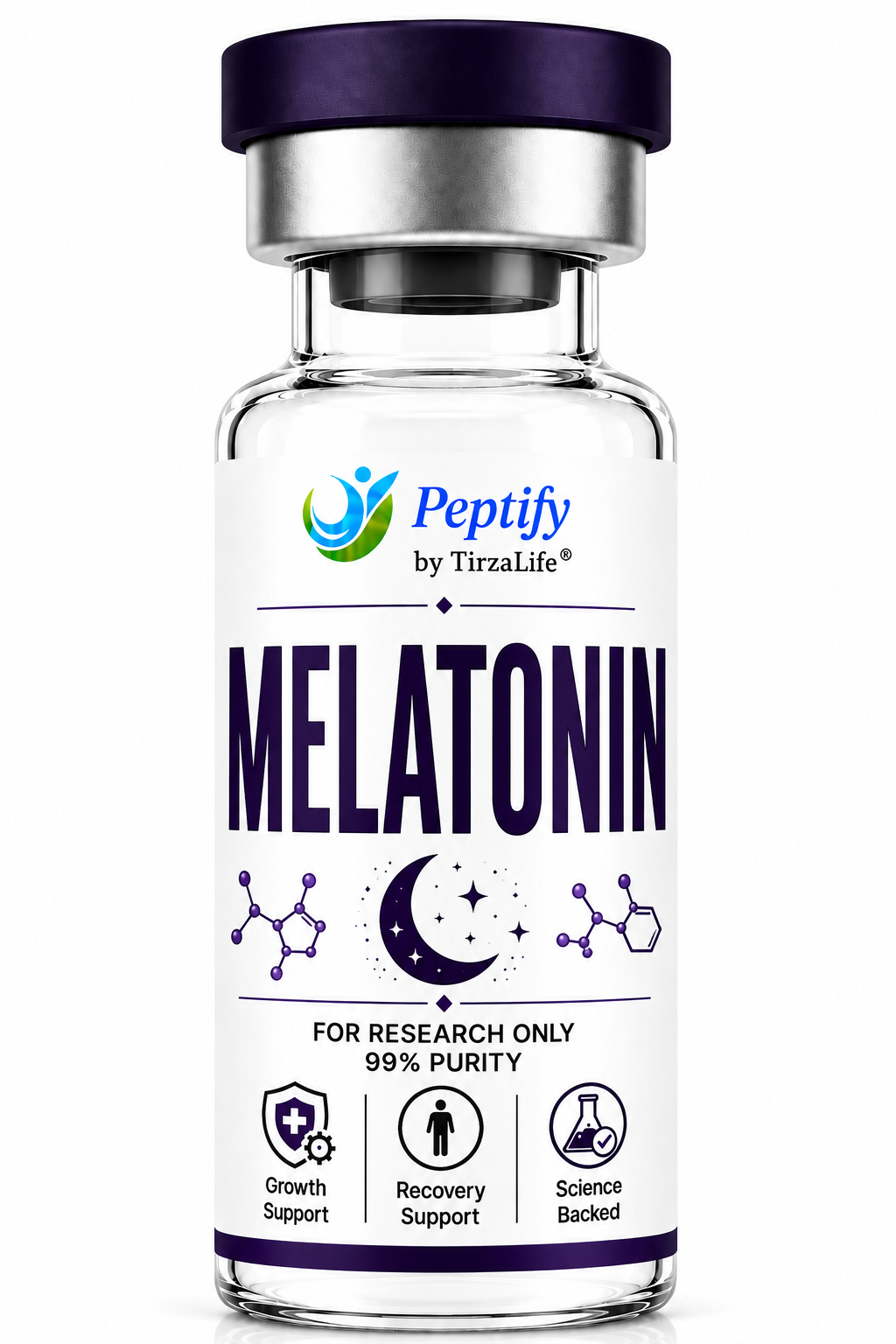
Melatonin 10mg
A sleep-wellness entry for circadian biology, medication review, and safety screening.
Contents
Use this guide as a structured review page. The same headings appear for every protocol so clients and the care team can scan the page consistently.
Protocol Overview
Melatonin is an endogenous hormone involved in circadian rhythm signaling and sleep-wake timing. A 10mg product should be reviewed for next-day sedation, pregnancy or pediatric use, seizure or autoimmune history, anticoagulants, sedatives, blood-pressure or diabetes medications, and clinician guidance rather than broad sleep-cure claims.
- Circadian rhythm context
- Sleep-timing review
- Medication and sedation screening
- Clinician-guided safety discussion
Recommended Source
This protocol is linked to the workbook reference source below.
- Melatonin Dosage Protocol Guide — Timing & Titration Open source
Important Note
This page is informational and does not authorize use. Peptify clients should complete assessment, disclose medications and health history, and follow the clinician-approved plan only.
- Do not start, stop, combine, or change a protocol based only on website content.
- Emergency symptoms require urgent medical care, not a website or routine follow-up message.
Quickstart Highlights
You're likely taking it too close to bedtime. Move your dose window 30 minutes earlier. From 60 minutes before bed to 90–120 minutes before. If you've already tried that and sleep latency remains high, the issue may be circadian misalignment rather than insufficient melatonin receptor activation. Consider whether your sleep environment supports melatonin's mechanism: blue light exposure from screens in the hour before bed suppresses endogenous melatonin and counteracts supplementation. Dim all lights, eliminate screens 60+ minutes before target sleep, and ensure room temperature is below 68°F. Heat disrupts the thermogenic drop required for sleep onset.
- Melatonin's effective dose for most adults is 0.3–1mg, not the 5–10mg doses commonly sold. Receptor saturation limits benefit beyond 3mg.
- Timing relative to your dim light melatonin onset (DLMO) determines whether melatonin advances or delays your circadian phase. The same dose produces opposite effects at different times.
- Immediate-release formulations peak in plasma concentration 60–90 minutes post-dose, requiring administration 90–120 minutes before target sleep time.
- Supraphysiological doses (5mg+) increase next-day grogginess in slow metabolisers without proportional sleep benefit due to receptor occupancy ceilings.
- Consistent daily timing is essential for circadian entrainment. Irregular dosing schedules undermine the protocol's phase-shifting effectiveness.
- You're either dosing too high or you're a slow CYP1A2 metaboliser. Cut your dose in half. If you're taking 3mg, drop to 1.5mg. If grogginess persists at 1mg or lower, switch to immediate-release formulations instead of extended-release, which maintain elevated plasma levels longer and increase residual morning sedation risk. Slow metabolisers clear melatonin 30–50% slower than fast metabolisers, meaning a 3mg dose taken at 10 PM may still be partially active at 7 AM. Genetic testing can confirm CYP1A2 status, but empirical dose reduction is faster and equally effective.
- You're likely dosing at the wrong circadian phase for your destination time zone. Eastward travel (losing hours) requires advancing your clock. Take melatonin in the late afternoon/early evening at your destination, not at your home-time equivalent of bedtime. Westward travel (gaining hours) requires delaying your clock. Skip melatonin the first night and prioritise morning light exposure at the destination instead. Jet lag protocols are phase-shift strategies, not sleep aids. Timing relative to the new time zone's light-dark cycle is what drives re-entrainment.
- Here's the honest answer: most melatonin supplementation fails because people use it like a sleeping pill instead of a circadian tool. The supplement industry has conditioned consumers to think higher doses work better, which is pharmacologically incorrect. Melatonin receptor occupancy saturates at low doses, and exceeding that threshold doesn't improve outcomes. The 10mg gummies sold at every drugstore are a marketing construct, not a clinical recommendation. Peer-reviewed dose-finding studies consistently show 0.3–1mg is physiologically optimal, yet the average retail product contains 5–10× that amount.
- The second uncomfortable truth: melatonin won't fix poor sleep hygiene. If you're taking 5mg at 11 PM while scrolling Instagram in a 72°F bedroom with ambient light, the melatonin isn't the limiting factor. Your behavior is. The supplement modulates circadian signaling, but it can't override sustained blue light exposure, thermal dysregulation, or irregular sleep-wake schedules. A proper melatonin dosage protocol guide includes the behavioral context required for the hormone to function as intended. Supplement without structure delivers inconsistent results.
- No. Abrupt cessation after chronic high-dose use can temporarily disrupt endogenous melatonin production as your pineal gland readjusts. Taper your dose by 25–30% every 5–7 days: 10mg → 7mg → 5mg → 3mg → 1mg → 0.5mg → discontinue. During the taper, maintain strict sleep-wake timing and dim light exposure in the evening to support your body's natural melatonin secretion. Most people restore baseline endogenous production within 2–3 weeks of stopping exogenous supplementation, but the taper minimises rebound insomnia during the transition.
- You take melatonin in the morning after your shift ends, not before your daytime sleep window. Shift workers need to delay their circadian phase so their body interprets daytime as nighttime. Taking 0.5–1mg upon arriving home (around 7–8 AM) signals the SCN to shift the clock forward, making it easier to fall asleep at 9 AM. Combine this with blackout curtains, eye masks, and avoiding bright light on the commute home. Melatonin alone won't override a misaligned circadian rhythm. Light exposure is the dominant zeitgeber (time cue), so managing light is equally critical.
- Melatonin protocols operate at the intersection of pharmacology, circadian biology, and behavioral context. The molecule itself is simple. An indoleamine hormone synthesised from serotonin in the pineal gland. The complexity lies in how, when, and why you use it. A melatonin dosage protocol guide that ignores timing relative to DLMO, phase response curves, and receptor saturation thresholds is incomplete. Most commercially available protocols do exactly that. They provide a dose and say 'take before bed,' which is sufficient for neither sleep onset optimization nor circadian realignment.
- Our experience working with peptides and hormones in research contexts taught us that precision dosing isn't optional when working with signaling molecules. Melatonin is no exception. Start low (0.5mg), time it 90–120 minutes before your target sleep onset, maintain daily consistency, and adjust based on measured outcomes. Sleep latency, wake time, next-day alertness. If the protocol isn't working after 2–3 weeks, the issue is rarely 'not enough melatonin'. It's misaligned timing, poor sleep environment, or an underlying circadian rhythm disorder that requires clinical evaluation beyond supplementation.
- The physiologically effective dose for most adults is 0.3–1mg taken 90–120 minutes before target sleep onset. Clinical studies from MIT and other institutions demonstrated that 0.3mg produces plasma melatonin levels (60–150 pg/mL) comparable to the body’s natural nocturnal peak. Higher doses saturate MT1 and MT2 receptors without proportional benefit — doses above 3mg are pharmacologically excessive for sleep onset in neurotypical adults.
- Immediate-release melatonin reaches peak plasma concentration 60–90 minutes after oral ingestion, which is why protocols recommend taking it 90–120 minutes before your target sleep time. Sublingual formulations bypass first-pass metabolism and peak in 20–40 minutes, but bioavailability varies significantly across products. Food — especially high-fat meals — delays absorption and can push peak concentration out to 2+ hours.
- Melatonin does not produce pharmacological dependence the way benzodiazepines or Z-drugs do, and tolerance to its circadian-regulating effects is minimal in most users. However, chronic supraphysiological dosing (5mg+ nightly) may downregulate MT1/MT2 receptor expression over months, reducing efficacy. Cycling off melatonin for 1–2 weeks every 2–3 months can prevent receptor desensitisation if you’re using doses above 3mg regularly.
- Immediate-release formulations deliver the full dose rapidly, reaching peak plasma concentration in 60–90 minutes and clearing within 4–6 hours — ideal for sleep onset issues. Extended-release formulations stretch absorption over 4–6 hours to mimic the body’s natural melatonin secretion curve, theoretically supporting sleep maintenance. Clinical evidence favoring extended-release for middle-of-the-night awakenings is mixed, and many sleep medicine specialists still prefer immediate-release for predictability.
- Consistency is essential — melatonin’s circadian entrainment effect requires repeated phase cues at the same time each day. Taking it at 9 PM one night and 11 PM the next trains your suprachiasmatic nucleus poorly, undermining phase-shift effectiveness. Set a daily alarm 90 minutes before your target sleep time and dose then, every night, for at least 2–3 weeks to allow circadian adaptation to stabilise.
- Morning grogginess typically results from either dosing too high or being a slow CYP1A2 metaboliser, which clears melatonin 30–50% slower than average. Cut your dose in half — if you’re taking 3mg, drop to 1.5mg. If grogginess persists at ≤1mg, switch from extended-release to immediate-release formulations, which clear faster. Slow metabolisers may still have residual melatonin in plasma 8–10 hours post-dose with supraphysiological dosing.
- Eastward travel (losing hours) requires advancing your circadian clock — take 0.5–3mg in the late afternoon or early evening at your destination, 4–6 hours before the new local bedtime. Westward travel (gaining hours) requires delaying your clock — skip melatonin the first night and prioritise morning light exposure at the destination instead. Jet lag protocols manipulate phase response curves, not sleep onset directly, so timing relative to the destination’s light-dark cycle is critical.
- Melatonin is generally safe to combine with non-sedative sleep-supporting supplements like magnesium (glycinate or threonate forms) and L-theanine, which modulate GABAergic activity without direct receptor overlap. However, combining melatonin with other sedatives — alcohol, benzodiazepines, antihistamines — compounds CNS depression and increases next-day impairment risk. Always disclose supplement use to your prescribing physician if you’re on medication.
- DLMO is the point in the evening when your endogenous melatonin begins rising under dim lighting conditions — typically 2–3 hours before habitual sleep onset. Supplemental melatonin taken 4–6 hours before DLMO advances your circadian phase (shifts sleep earlier); taken 30–60 minutes before DLMO supports sleep onset without major phase shift. Understanding your DLMO allows precise timing for either circadian realignment or acute sleep latency reduction.
- Melatonin has a wide safety margin — doses up to 10mg are generally well-tolerated in short-term use, and toxicity is rare even at much higher doses. However, pharmacological efficacy plateaus at 1–3mg due to receptor saturation, meaning doses above 3mg don’t produce proportionally better outcomes. Chronic high-dose use (10mg+ nightly) may downregulate receptor expression and increase morning grogginess in slow metabolisers, making lower doses both safer and more effective.
- Research Blogs Open source
- Popular Peptides Open source
- Get Free Guide Open source
- Our Ambassadors Open source
- Become an Affiliate Open source
- Affiliate Login Open source
- Affiliate Portal Open source
- support@realpeptides.co
- +1 813-330-0290
- All products on this site are for research and development use only. Products are not for human consumption of any kind. The statements made on this website have not been evaluated by the US Food and Drug Administration. The statements and the products of this company are not intended to diagnose, treat, cure, or prevent any disease.
- Real Peptides is a chemical supplier. Real Peptides is not a compounding pharmacy or chemical compounding facility as defined under 503A of the Federal Food, Drug, and Cosmetic Act. Real Peptides is not an outsourcing facility as defined under 503B of the Federal Food, Drug, and Cosmetic Act.
- All products are sold for research, laboratory, or analytical purposes only, and are not for human consumption.
- © 2025 Real Peptides.
- Privacy policy Open source
- Refund policy Open source
- Shiping policy Open source
- Contact information Open source
- Login
- Register
- End of Content.
References
Reference source used for this protocol page.
- Melatonin Dosage Protocol Guide — Timing & Titration Open source
- Peptify Reconstitution Guide