
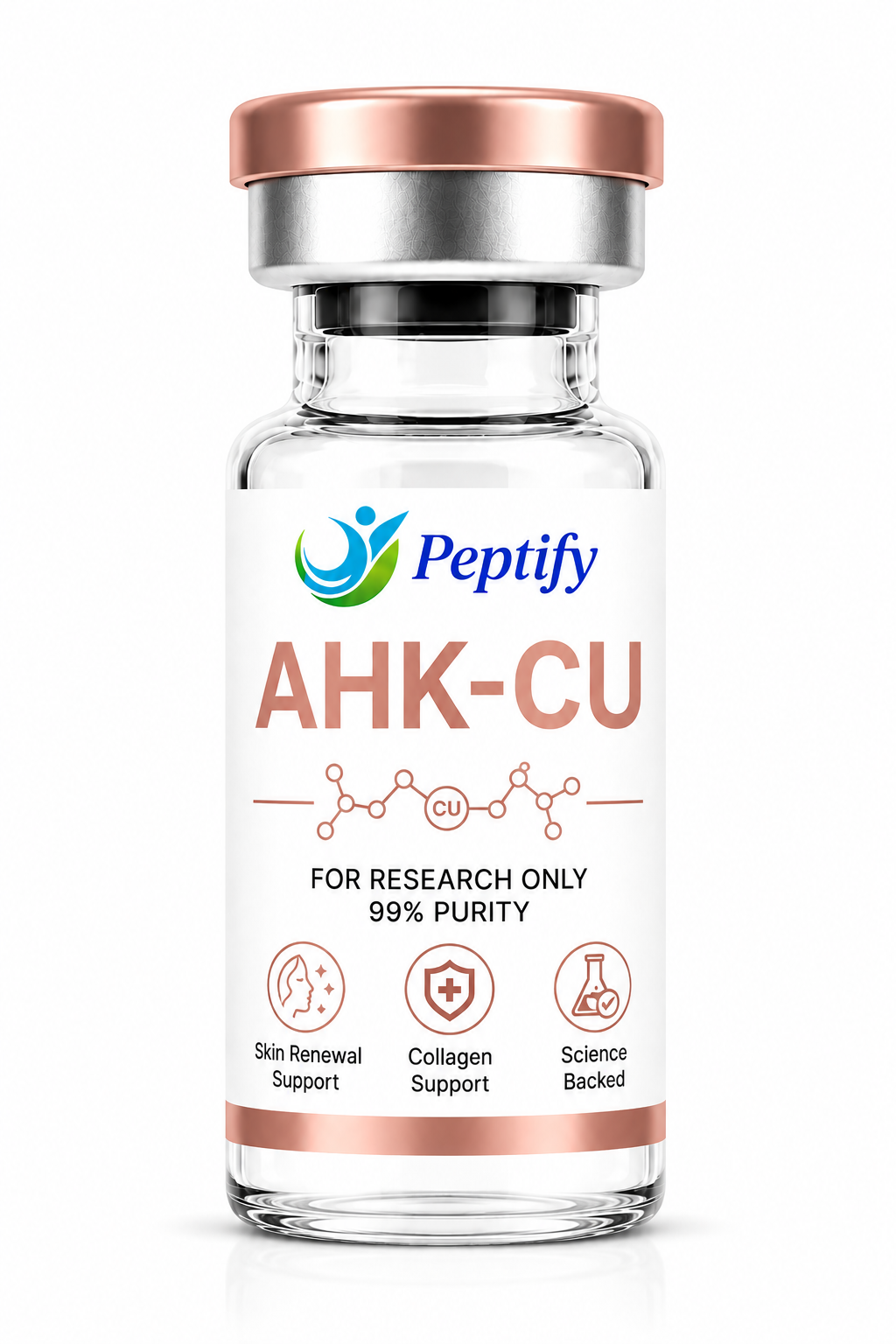
AHK-CU 20mg
A copper-peptide entry for skin and hair literature review, product quality, and safety screening.
Contents
Use this guide as a structured review page. The same headings appear for every protocol so clients and the care team can scan the page consistently.
Protocol Overview
AHK-Cu is a copper-binding tripeptide discussed in cosmetic and research contexts related to skin, hair-follicle biology, extracellular-matrix signaling, and wound-response pathways. Review should confirm route, copper exposure, dermatologic history, formulation quality, and clinician guidance, with no guaranteed hair-growth or anti-aging claims.
- Copper-peptide research context
- Skin and hair literature review
- Copper exposure screening
- Product quality verification
Recommended Source
This protocol is linked to the workbook reference source below.
- AHK-Cu Dosage Guide: How Much Should You Take? (2026) Open source
Quickstart Highlights
AHK-Cu is a three–amino-acid peptide — alanine, histidine, lysine — bound to a copper(II) ion. In cosmetic ingredient listings it is generally sold under the name Copper Tripeptide-3.
| Product type | Typical concentration | Notes |
|---|---|---|
| Finished cosmetic sprays and serums | 0.05% – 1% | The form with the longest commercial history |
| Combined AHK-Cu / GHK-Cu formulas | 1:1 ratio, varying totals | Marketed for scalp use |
| Raw liposomal concentrates | 7% – 10% | Sold for dilution, not direct use |
| Lyophilised powder | Sold by mass | Requires reconstitution |
- AHK-Cu (L-alanyl-L-histidyl-L-lysine-Cu²⁺) has been studied in exactly one published experiment on human tissue — a 2007 laboratory study on isolated hair follicles and cultured dermal papilla cells[1]
- No human clinical trial of AHK-Cu has ever been conducted, and no pharmacokinetic study exists, so there is no measured bioavailability, half-life or blood level for this peptide by any route
- No published study has injected AHK-Cu into a human being. Injection protocols circulating online are vendor convention, not research findings
- The 2007 study found effects at picomolar to nanomolar concentrations (10⁻¹² to 10⁻⁹ M) — millions of times lower than the percentages sold in topical products
- AHK-Cu is a cosmetic ingredient, not an FDA-approved drug, and it is not on the WADA prohibited list
- Its better-studied relative GHK-Cu carries substantially more published evidence, and much of what circulates as "AHK-Cu research" is actually GHK-Cu research
- It is frequently confused with GHK-Cu, and the confusion is not harmless. The two differ by a single amino acid: GHK begins with glycine, AHK with alanine. That one substitution changes the mass, and it changes which body of research applies.
- If you have read that AHK-Cu weighs 340 Da, that figure is GHK's, not AHK's. It is one of the more common errors in circulation, and it is a reliable signal that whatever else the source says about AHK-Cu was probably written about GHK-Cu.
- This is the most common question asked about this peptide, so it deserves a direct answer rather than a protocol table.
- No published study has ever injected AHK-Cu into a human. A search of PubMed for AHK-Cu combined with injection, subcutaneous or intradermal administration returns nothing. The single AHK-Cu study applied the peptide to isolated tissue in a dish[1]. There is no injected dose, no injection interval, and no injection safety data for this molecule, because the experiment has not been done.
- That means any "AHK-Cu injection protocol" — including doses in milligrams, weekly schedules, or reconstitution volumes — is a vendor or forum convention. It may describe what people do. It does not describe what has been tested.
- One human study comes near this question, and it is worth understanding precisely because of what it does and does not show.
- In 2018, Kapoor and Shome reported intradermal scalp injections in 1,000 patients using a formulation that contained copper tripeptide-1 alongside vascular endothelial growth factor, basic fibroblast growth factor, insulin-like growth factor, keratinocyte growth factor and thymosin β4. Patients received injections every three weeks for eight sessions. Eighty-three percent showed reduced hair fall on the hair pull test, and total hair count remained significantly increased at one year (p = 0.002). Treatment was well tolerated[2].
- Four caveats determine how much weight that carries:
- The copper peptide used was copper tripeptide-1 — GHK-Cu, not AHK-Cu.
- It was one of six active ingredients, so no effect can be attributed to the copper peptide specifically.
- The study was open-label and single-arm with no control group, which is the design most prone to overstating benefit in hair-loss research.
- The route was intradermal into the scalp, performed in a clinic — not subcutaneous self-injection.
- A 2026 narrative review in the American Journal of Sports Medicine assessed injectable peptide therapy across the compounds most marketed to patients and concluded that while GHK-Cu shows promise in wound healing and anti-inflammatory work, no clinical data support its injectable use[3]. That conclusion applies with more force to AHK-Cu, which has a fraction of GHK-Cu's evidence.
- Copper peptides are not simply peptides. Copper is a trace metal the body regulates tightly, and the topical route the research used keeps exposure local. Injection bypasses that. There is no published measurement of what systemic copper load results from injecting a copper peptide, at any dose, which means the question cannot currently be answered from evidence in either direction.
- There is a further problem, and it is a matter of reasoning about delivery rather than a study finding.
- Injection is usually assumed to be the more potent route, on the logic that it bypasses absorption barriers. For a molecule whose target is a specific patch of scalp, that logic runs backwards. A subcutaneous injection distributes a compound through the systemic circulation, diluting it across the whole body before any of it reaches the dermal papilla cells at a thinning hairline. Topical application to the scalp is the more targeted route, not the weaker one.
- This is also why the one human study that comes closest used intradermal injection directly into scalp skin rather than subcutaneous injection[2] — the delivery was deliberately local.
- Separately from what the molecule does, there is the question of what is in the vial.
- Sterility, endotoxin limits and particulate control are properties of a manufacturing process, not of a peptide. Material sold as "research grade" or "not for human consumption" is not produced to the standards required for anything entering the body, and purity testing by HPLC measures how much of the compound is present — not whether the preparation is sterile or endotoxin-free. Those are different tests, and a certificate of analysis showing 99% purity does not speak to either.
- The single published AHK-Cu experiment came from the Department of Dermatology at Seoul National University and appeared in Archives of Pharmacal Research in 2007[1]. It is worth reporting in detail, because it is the entire evidence base.
- Researchers applied AHK-Cu to two preparations: human hair follicles isolated and kept alive outside the body, and cultured dermal papilla cells — the specialised fibroblasts at the base of a follicle that govern whether hair grows.
- What it showed. At concentrations from 10⁻¹² to 10⁻⁹ M, AHK-Cu stimulated elongation of the isolated follicles and proliferation of dermal papilla cells. At 10⁻⁹ M, the ratio of Bcl-2 to Bax rose and the cleaved forms of caspase-3 and PARP fell — a pattern consistent with cells being protected from programmed cell death.
- What it did not show. The reduction in the number of apoptotic dermal papilla cells at 10⁻⁹ M did not reach statistical significance, a limitation the authors state plainly. The work also confirmed a general property of tripeptide-copper complexes: they increase dermal fibroblast proliferation and vascular endothelial growth factor production while decreasing transforming growth factor-beta1 secretion.
- This is a genuine and reasonably encouraging result. It is also a laboratory result on isolated tissue, and nineteen years later it has not been followed by a human trial.
- The 2007 study found its effects between 10⁻¹² and 10⁻⁹ M. Converting those to the units products are sold in is revealing:
- There is a legitimate reason a topical product is not formulated at 10⁻⁹ M: a molecule applied to intact skin must cross the stratum corneum, and only a fraction of what is applied reaches living tissue. Formulators compensate by increasing concentration.
- But the size of that gap has never been measured for AHK-Cu. No skin-penetration study of this peptide exists, so nobody can say what tissue concentration a 1% solution actually produces, or whether it lands anywhere near the range that worked in the dish. Treat any product claiming a specific percentage is "optimal" with scepticism — the study that would establish optimal has not been run.
- Worth noting too: the 2007 data showed effects at the low end of its range. More is not established to be better, and copper peptides have shown reduced activity at higher concentrations in other contexts.
- The figures below describe what the market sells, not what research validates. They are formulation convention, offered so you can interpret a label — not a recommendation.
- Copper peptide solutions are naturally blue to blue-violet. That colour comes from the copper complex itself. A solution that has turned brown, green or colourless has degraded, and the copper-peptide complex is also destabilised below about pH 5.0 — which is why layering these with low-pH vitamin C or exfoliating acid products is generally discouraged.
- The mechanism below is drawn from the 2007 study and from the broader copper-tripeptide literature. It describes plausible biology, not demonstrated clinical benefit.
- Dermal papilla cells. These specialised fibroblasts sit at the base of each follicle and control the hair cycle. AHK-Cu increased their proliferation in culture[1].
- Anti-apoptotic signalling. The rise in Bcl-2/Bax ratio and fall in cleaved caspase-3 and PARP point toward cells being held back from programmed death — the process that drives follicle miniaturisation[1].
- VEGF and TGF-β1. Tripeptide-copper complexes raise vascular endothelial growth factor, which supports the blood supply feeding a follicle, and lower transforming growth factor-beta1, a signal associated with the follicle entering its regression phase[1].
- The honest summary is that this is a coherent mechanistic story with laboratory support and no clinical confirmation.
- These are properties of peptide chemistry, and they hold regardless of the evidence question.
- Lyophilised powder is stable frozen. Keep it dry and dark; moisture is the main enemy.
- Reconstituted or in-solution product belongs refrigerated, and copper peptide solutions degrade faster at room temperature and in light.
- Colour is your indicator. Blue to blue-violet is intact. Brown, green or colourless means degraded.
- Avoid low pH. Below roughly pH 5.0 the copper-peptide complex destabilises.
- Do not combine in the same application with strong acids or high-concentration vitamin C.
- No formal safety study of AHK-Cu exists in humans, so the following reflects the general behaviour of topical copper peptides rather than trial data.
- Reported effects with topical copper peptides are typically local: irritation, itching, redness at the application site, and occasional contact sensitivity in people who react to copper or to peptide preservatives. Applying to broken or infected skin, or near the eyes, is generally avoided.
- Greater caution is warranted for anyone with Wilson's disease or another copper-handling disorder, since these conditions impair the body's ability to regulate copper. People who are pregnant or breastfeeding have not been studied. Neither have children.
- Because there is no systemic exposure data for AHK-Cu by any route, the safety of injected or large-surface-area use cannot be characterised.
- Stated plainly, so it cannot be mistaken for modesty about strong data:
- No human clinical trial. Not one, in any indication.
- No pharmacokinetic data. No bioavailability figure, no half-life, no tissue concentration measurement, by any route.
- No skin penetration study. How much of a topical dose reaches the dermal papilla is unknown.
- No dose-response study in humans. The "optimal" concentration is not established.
- No injection study. No dose, schedule or safety profile for injected AHK-Cu exists.
- No long-term safety data, and no data in pregnancy, breastfeeding or children.
- No head-to-head comparison against minoxidil, finasteride or GHK-Cu.
- Anyone presenting a precise bioavailability percentage, a half-life in hours, or a milligram injection protocol for AHK-Cu is not reporting a measurement. Those numbers do not exist in the literature.
- If your interest is the strongest-evidenced copper peptide, it is GHK-Cu, and it is not close. GHK-Cu occurs naturally in human plasma, has been studied since the 1970s, and has dozens of published papers including work on wound healing, skin remodelling and gene expression. Our GHK-Cu dosing guide covers that evidence in detail.
- AHK-Cu's appeal is narrower and specific: the one study that exists looked directly at hair follicles and dermal papilla cells, which is precisely the tissue people using it care about. That is a real point in its favour — it just rests on a single laboratory experiment rather than a body of work.
- The practical consequence is that a great deal of material marketed as AHK-Cu evidence is GHK-Cu evidence wearing a different label. When you encounter a study cited on an AHK-Cu page, check which peptide it actually examined.
How This Works
There is no established dose. No human trial has been conducted, so no dose has been validated for any purpose. Topical products commonly contain between 0.05% and 1%, which reflects formulation convention rather than a tested optimum.
- No published study has injected AHK-Cu into a human by any route, so there is no established injection dose, schedule or safety profile. The nearest human evidence used a different copper peptide — copper tripeptide-1, better known as GHK-Cu — as one of six ingredients, delivered intradermally in a clinic[2]. A 2026 review concluded that no clinical data support injectable copper peptide use[3].
- Reconstitution volume is a dilution choice, not a dose, and it does not answer the question of whether injecting this peptide is supported — it is not. If you hold a lyophilised vial, the volume you add determines concentration per unit volume and nothing else.
- Unknown. No human study has measured a time course. Hair follicle cycles run in months, so any claimed timeline of "results by week 4" is not derived from AHK-Cu research.
- No. AHK-Cu has no FDA drug approval and is sold as a cosmetic ingredient or a research chemical. It is not an approved treatment for hair loss or any other condition.
- AHK-Cu does not appear on the WADA Prohibited List.
- They are commonly formulated together, and there is no known chemical incompatibility. No study has tested the combination, so no additive benefit has been demonstrated.
- Reported effects with topical copper peptides are local — irritation, redness, itching, occasional contact sensitivity. See our AHK-Cu side effects guide for detail. Systemic effects are uncharacterised because systemic exposure has never been measured.
- AHK-Cu rests on one 2007 laboratory study that produced a genuinely interesting result on human hair follicles kept alive in a dish. That study has not been followed up in humans in nearly two decades.
- Everything that would let you dose this peptide with confidence — bioavailability, penetration, dose-response, safety at a given exposure — has not been measured. That is not a reason to dismiss it, but it is the reason no honest source can hand you a protocol.
- If you use it, the topical route is the one the research examined, and lower concentrations are closer to what worked in the study. If you are looking for the copper peptide with actual evidence behind it, that is GHK-Cu.
References
Reference-derived details for AHK-CU 20mg.
- AHK-Cu Dosage Guide: How Much Should You Take? (2026) Open source
- Pyo HK, Yoo HG, Won CH, Lee SH, Kang YJ, Eun HC, Cho KH, Kim KH. "The effect of tripeptide-copper complex on human hair growth in vitro." Arch Pharm Res. 2007 Jul;30(7):834-9. PMID: 17703734 Open source
- Kapoor R, Shome D. "Intradermal injections of a hair growth factor formulation for enhancement of human hair regrowth — safety and efficacy evaluation in a first-in-man pilot clinical study." J Cosmet Laser Ther. 2018 Oct;20(6):369-379. PMID: 29482481 Open source
- Mayfield CK, Bolia IK, Feingold CL, Lin EH, Liu JN, Rick Hatch GF, Gamradt SC, Weber AE. "Injectable Peptide Therapy: A Primer for Orthopaedic and Sports Medicine Physicians." Am J Sports Med. 2026 Jan;54(1):223-229. PMID: 41476424 Open source
Important Note
This page is informational and does not authorize use. Peptify clients should complete assessment, disclose medications and health history, and follow the clinician-approved plan only.
- Do not start, stop, combine, or change a protocol based only on website content.
- Emergency symptoms require urgent medical care, not a website or routine follow-up message.