
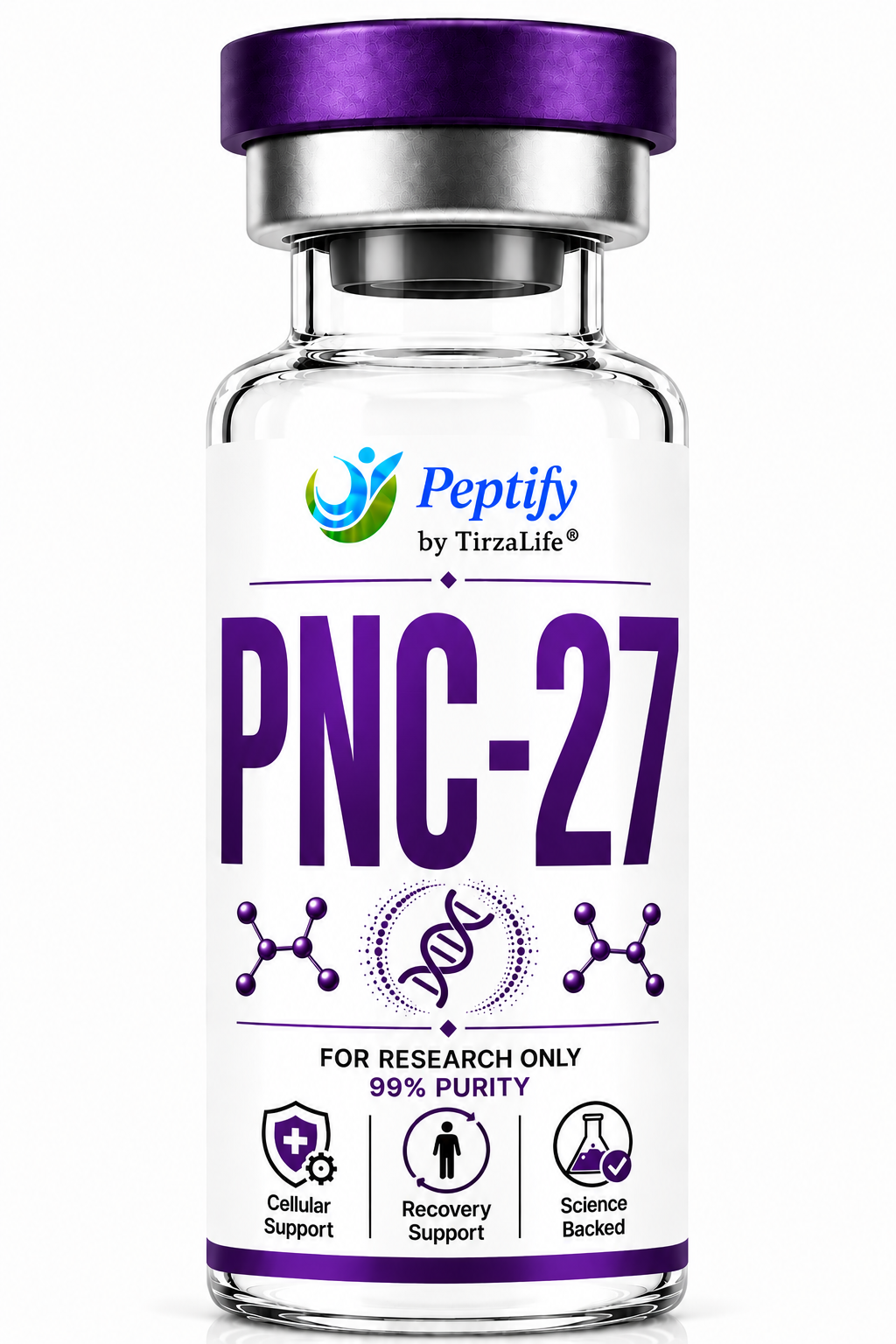
PNC-27 10ml
A high-caution oncology-research peptide entry for product identity and safety review.
Contents
Use this guide as a structured review page. The same headings appear for every protocol so clients and the care team can scan the page consistently.
Important Note
This page is informational and does not authorize use. Peptify clients should complete assessment, disclose medications and health history, and follow the clinician-approved plan only.
- Do not start, stop, combine, or change a protocol based only on website content.
- Emergency symptoms require urgent medical care, not a website or routine follow-up message.
Dosing & Reconstitution Guide
A single practical dilution with accurate once-daily dosing, step by step
| Phase / Week(s) | Dose & Frequency | Volume (U-100 units / mL) |
|---|---|---|
| Weeks 1–2 | 100 mcg (1× daily) | 1 unit (0.01 mL) |
| Weeks 3–4 | 200 mcg (1× daily) | 2 units (0.02 mL) |
| Weeks 5–8 | 300 mcg (1× daily) | 3 units (0.03 mL) |
| Weeks 9–12 | 400 mcg (1× daily) | 4 units (0.04 mL) |
| Weeks 13–16 | 500 mcg (1× daily) | 5 units (0.05 mL) |
- Reconstitute: Add 3.0 mL bacteriostatic water to one 30 mg vial → final concentration 10 mg/mL (10,000 mcg/mL).
- Typical daily range: 100–500 mcg once daily, raised gradually over a 16-week course.
- Easy measuring: At 10 mg/mL, 1 unit = 0.01 mL = 100 mcg on a U-100 syringe, so units = mcg ÷ 100. Each step lands on a whole unit mark.
- Storage: Lyophilized: store at −20 °C (−4 °F); after reconstitution, refrigerate at 2–8 °C (35.6–46.4 °F) and do not freeze the mixed solution.
Quickstart Highlights
PNC-27 is a synthetic 32-amino-acid chimeric peptide that fuses an HDM-2-binding domain from the p53 tumor-suppressor protein (residues 12–26) to a membrane-penetrating leader sequence, studied preclinically for selective membrane disruption of cancer cells that abnormally express HDM-2[1][2]. The FDA has publicly warned consumers not to use PNC-27 products marketed as cancer treatments — they are unapproved, unproven, and tested samples have been found contaminated. No human clinical trials exist; this is an unapproved research chemical, presented for research and educational use only.
- Add 3.0 mL bacteriostatic water to one 30 mg vial → 10 mg/mL (10,000 mcg/mL), giving simple insulin-syringe measurements.
- 100–500 mcg once daily, titrated upward gradually across a 16-week course. No authoritative human dose exists — higher doses are speculative.
- At 10 mg/mL, 1 unit = 0.01 mL = 100 mcg; 100 mcg = 1 unit and 500 mcg = 5 units on a U-100 syringe.
- Lyophilized: store at −20 °C (−4 °F); once reconstituted, refrigerate at 2–8 °C (35.6–46.4 °F) and do not freeze the solution.
- Important: Start with the Prep & Injection Guide — it covers the preparation and safety basics every protocol on this site assumes.
- Frequency: one subcutaneous injection each day over 16 weeks, titrating up as tolerated (units = mcg ÷ 100). No authoritative human dose exists for PNC-27; any dose above a few hundred micrograms per day is purely speculative. These figures are an educational extrapolation, not an approved human dosing schedule.
Reconstitution Steps
Draw 3.0 mL of bacteriostatic water into a sterile syringe.
- Release it slowly down the vial’s inner wall to limit foaming.
- Swirl or roll gently until fully dissolved — don’t shake.
- Label with the date and concentration, then refrigerate at 2–8 °C (35.6–46.4 °F), shielded from light.
- At 10 mg/mL, doses land on whole insulin-syringe units (1 unit = 100 mcg), keeping measurement simple and consistent. Avoid freezing the reconstituted solution, since freeze–thaw can denature the peptide.
- Important: This guide is for educational purposes only and is not medical advice. For research use only. Not for human consumption.
Supplies Needed
Quantities below assume an 8–16 week course of once-daily injections with gradual titration.
- At 100–500 mcg/day, a 30 mg vial covers most of a 16-week course; plan one to two vials total.
- 8 weeks: ~1 vial
- 12 weeks: ~1 vial
- 16 weeks: ~2 vials
- Per week: 7 syringes
- 8 weeks (once daily): ~56 syringes
- 16 weeks (once daily): ~112 syringes
- Use 3.0 mL per 30 mg vial for reconstitution.
- 8 weeks (1 vial): 3 mL → 1 bottle
- 16 weeks (2 vials): 6 mL → 1 bottle
- One for the vial stopper + one for the injection site each day.
- Per week: 14 swabs
- 16 weeks (once daily): ~224 swabs → 3 boxes
Protocol Overview
A concise summary of the once-daily regimen. PNC-27 has no authoritative human dose; this is an educational extrapolation only.
- ▪Goal: Educational exploration of a p53-derived peptide studied preclinically for selective cancer-cell membrane disruption — observed only in cell and mouse models, never established in humans[1][2].
- ▪Schedule: Once-daily subcutaneous injections across a 16-week titration (preclinical studies used intraperitoneal dosing, not SC).
- ▪Dose Range: 100–500 mcg per day with gradual titration. No authoritative human dose exists; higher amounts are speculative.
- ▪Reconstitution: 3.0 mL bacteriostatic water per 30 mg vial gives 10 mg/mL for simple unit measurements.
- ▪Storage: Keep the dry vial frozen at −20 °C (−4 °F); once mixed, refrigerate at 2–8 °C and do not freeze the solution.
Dosing Protocol
A suggested daily titration approach. These figures are educational extrapolations, not approved human doses.
- ▪Start: Begin at 100 mcg (1 unit) once daily for the first two weeks.
- ▪Titrate: Increase by ~100 mcg (1 unit) about every two to four weeks as tolerated.
- ▪Target: Reach about 300–500 mcg (3–5 units) daily by weeks 5–16.
- ▪Cycle Length: A 16-week titration; no human dosing has ever been validated.
- ▪Timing: Inject at a consistent time each day and rotate injection sites systematically.
Storage Instructions
Correct storage is what preserves the peptide’s stability and activity.
- ▪Lyophilized: Hold the dry vial at −20 °C (−4 °F) in dry, dark conditions and limit moisture exposure[7].
- ▪Reconstituted: Refrigerate at 2–8 °C (35.6–46.4 °F) and use within about 30 days; do not freeze the mixed solution, as freezing can denature peptides[8].
- ▪Handling: Let frozen vials warm to room temperature before opening so condensation won’t form, and keep the solution clear of heat and direct light.
- ▪Freeze–thaw: Avoid repeated freeze–thaw cycles of the reconstituted solution.
Important Notes
Practical points that keep daily administration safe and consistent.
- ▪Sterile technique: Use a fresh sterile U-100 insulin syringe each time and drop it straight into a puncture-proof sharps container afterward.
- ▪Site rotation: Move between abdomen, thighs and upper arms to reduce local irritation and lipohypertrophy[9].
- ▪Slow injection: Push the plunger slowly and pause a few seconds before withdrawing the needle to prevent backflow.
- ▪Recordkeeping: Log the daily dose, injection site and any observations to keep the protocol consistent.
- ▪FDA warning: The FDA has publicly warned consumers not to use PNC-27 products marketed as cancer treatments — they are unapproved and unproven, and tested samples were found contaminated. PNC-27 has no human trials and falls under WADA S0 (unapproved substances)[3].
How This Works
PNC-27 is a chimeric 32-amino-acid peptide: a segment of the p53 tumor-suppressor protein (the HDM-2-binding domain, residues 12–26) fused to a membrane-penetrating leader sequence[1][2]. The p53 portion is what targets HDM-2.
- Its proposed mechanism is binding to HDM-2 that is anomalously expressed on the membranes of cancer cells. There it is thought to form transmembrane pores, driving membranolysis and necrotic cell death while claiming to spare normal cells[2][6].
- All supporting evidence is preclinical only — cell-culture and mouse tumor models, in which growth inhibition was reported via intraperitoneal administration[4]. The necrotic, membrane-lysis mode of action is distinct from apoptosis[7].
- Critical safety caveat: there are no human clinical trials of PNC-27, and it is not FDA-approved. The FDA has publicly warned consumers not to use it as a cancer treatment; tested products were unapproved, unproven, and in at least one case contaminated (e.g., Variovorax paradoxus in an inhalable form), with potential for serious or fatal harm. This is not a usable cancer therapy.
- PNC-27 is not an approved medicine. It is an unapproved research chemical presented here for research and educational purposes only.
Lifestyle Factors
General supportive habits — not specific to PNC-27, which has no validated human use.
- ▪Nutrition: Maintain a balanced, nutrient-dense diet to support overall metabolic function.
- ▪Medical guidance: Consult a qualified healthcare professional before any experimental peptide use.
- ▪Sleep: Aim for 7–9 hours to support immune function and overall health.
- ▪Stress: Manage stress with evidence-based practices to support general wellbeing.
Potential Benefits & Side Effects
Observations from preclinical literature only — no human data exist for PNC-27.
- ▪Selective cytotoxicity (preclinical): Cell and mouse studies report selective killing of cancer cells expressing abnormal p53/HDM-2 while reportedly sparing normal cells[2][6].
- ▪Membrane-lysis mechanism (preclinical): Activity is attributed to direct membrane disruption and necrosis rather than apoptosis[7].
- ▪Route caveat: Preclinical results used intraperitoneal dosing in mice — not the subcutaneous route described here.
- ▪No human evidence: The FDA explicitly warns that PNC-27 safety and efficacy have not been established; no human trials exist[3].
- ▪Contamination risk: FDA testing found PNC-27 products contaminated (e.g., Variovorax paradoxus), posing risk of serious infection.
- ▪Unknown human safety: No human data exist; potential for serious or fatal harm cannot be ruled out.
- ▪Regulatory status: Unapproved and FDA-warned; falls under WADA S0 (unapproved substances) for athletes.
Injection Technique
General subcutaneous technique, following established clinical best-practice guidance.
- ▪Wash your hands well with soap and water.
- ▪Wipe the vial stopper with an alcohol swab and let it air-dry.
- ▪Choose a site (abdomen, thigh, or upper arm) and clean it with a fresh alcohol swab, letting it dry fully.
- ▪Draw the intended dose, then check for air bubbles and push any out.
- ▪Pinch a skinfold at the chosen site between thumb and forefinger.
- ▪Insert the needle into the pinch at a 45–90-degree angle (use 45 degrees if the fat layer is thin).
- ▪Skip aspiration for subcutaneous shots — it isn’t needed.
- ▪Press the plunger slowly and steadily until it’s fully down.
- ▪Wait 5–10 seconds, then pull the needle straight out to prevent leakage.
- ▪Drop the used syringe straight into a puncture-proof sharps container — never recap a needle.
- ▪Return the reconstituted vial to the fridge right away.
- ▪Rotate the injection site each day to prevent irritation and lipohypertrophy[9].
- ▪Watch the site for excess redness, swelling, or signs of infection.
Recommended Source
For high-purity research peptides, we point researchers to Prime Lab Peptides. (PNC-27 is not sold; this is a general supplier reference for research supplies only.)
- ▪Top-rated on Trustpilot: Independently reviewed as the highest-rated peptide lab on Trustpilot — making it the best current source in the USA. Open source
- ▪Third-party tested: Every batch ships with a Certificate of Analysis (COA) confirming purity and composition.
- ▪Consistent quality: ISO-aligned manufacturing and handling keep product integrity reliable batch to batch.
- ▪Cold-chain integrity: Temperature-controlled shipping and storage across the whole fulfilment chain.
- ▪Research-grade purity: Fit for educational and research use that demands high-quality peptides.
- Note: Product availability and specifications subject to change. Verify current product details on supplier website.
- Shop at Prime Lab Peptides →
References
Reference-derived details for PNC-27 10ml.
- PNC-27 (30 mg Vial) Dosage Protocol Open source
- 1 Journal of Biomedical Science (2017) Review of therapeutic peptides; PNC-27 mechanism and cancer-cell selectivity. View Source ↗ Open source
- 2 Cancer Chemotherapy and Pharmacology (2010) PNC-27 induces tumor-cell membrane lysis; preclinical mechanism study. View Source ↗ Open source
- 3 FDA Consumer Safety Communication Warning: PNC-27 products are unapproved, unproven, and tested samples were contaminated. View Source ↗ Open source
- 4 International Journal of Cancer (2006) PNC-28 (related peptide) blocks pancreatic cancer growth in vivo; mouse model study. View Source ↗ Open source
- 5 Peptide Sciences Peptide storage guidelines: lyophilized and reconstituted stability. View Source ↗ Open source
- 6 BMC Cancer (2008) PNC-27 selectively kills cancer cells via HDM-2 binding and membrane disruption. View Source ↗ Open source
- 7 PubMed (2012) PNC-27 peptide induces necrosis via a direct membrane-lysis mechanism. View Source ↗ Open source
- 8 Centers for Disease Control and Prevention (CDC) Subcutaneous injection technique: angle, site and no-aspiration guidance. View Source ↗ Open source
- 9 National Hemophilia Foundation (2021) Subcutaneous injection guidelines: needle length, angle and site preparation. View Source ↗ Open source
- 10 NCBI Bookshelf Best practices for injection: asepsis, preparation and administration. View Source ↗ Open source
- 11 Subcutaneous Drug Injection Review (PMC) Pharmacologic considerations of the subcutaneous route. View Source ↗ Open source
- 12 Prime Lab Peptides General research-peptide supplier reference (PNC-27 not sold). View Source ↗ Open source