
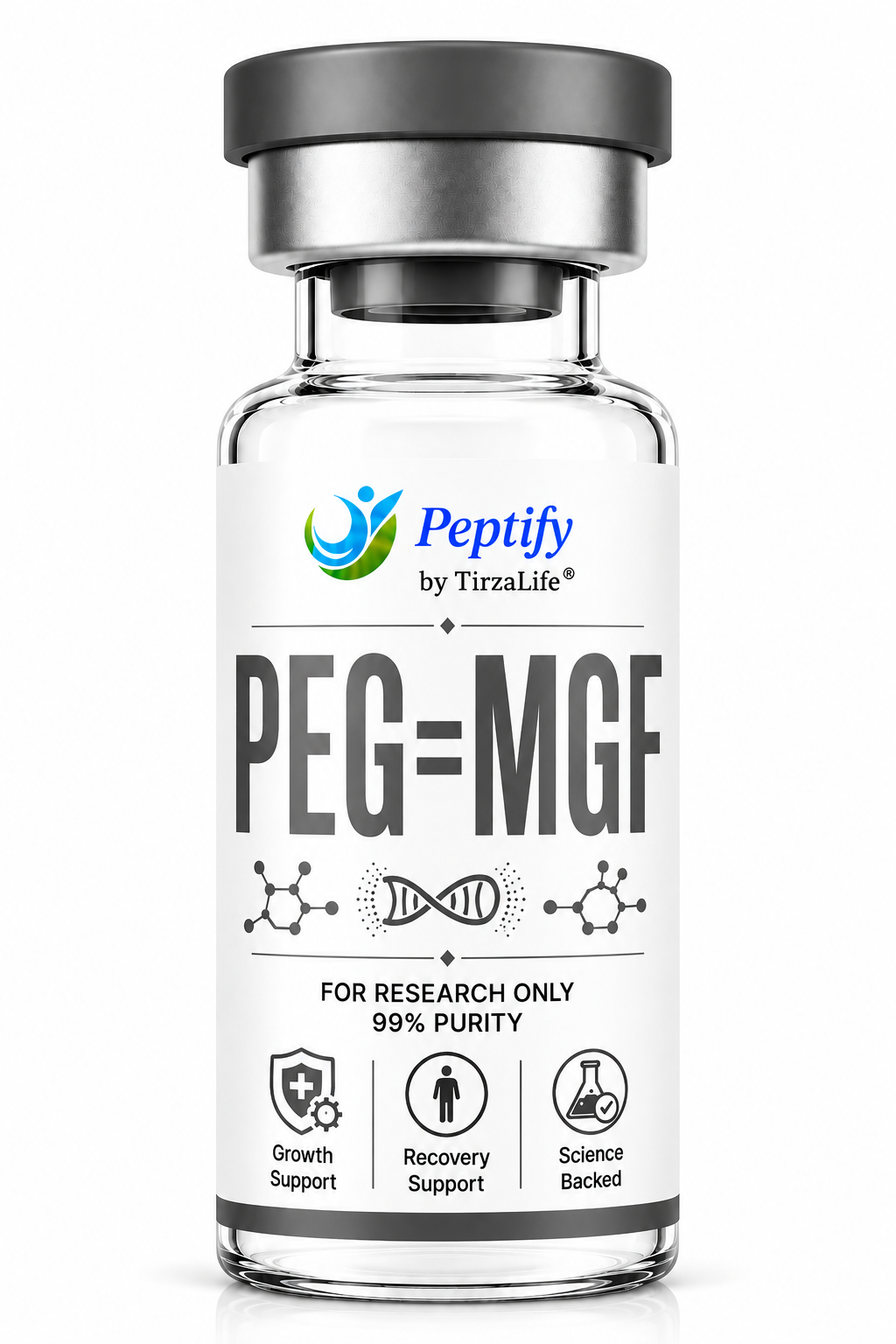
PEG MGF 2mg
A research-use growth-factor peptide entry for MGF/IGF biology context and safety review.
Contents
Use this guide as a structured review page. The same headings appear for every protocol so clients and the care team can scan the page consistently.
Quickstart Highlights
Reference-linked protocol details for PEG MGF 2mg.
- Reference title: PEG MGF Dosage Chart – 2 mg Vial Protocol | PeptideDosages.com
- Product: PEG MGF 2mg vial
- A research-use growth-factor peptide entry for MGF/IGF biology context and safety review.
- Source page: Open source
Dosing & Reconstitution Guide
Research context: For evidence on mechanisms, human and preclinical research, limitations, and safety, read PEG-MGF Peptide: Benefits, Uses, Side Effects, Dosage, and Research.
| Week | Daily Dose (mcg) | Units (per injection) (mL) |
|---|---|---|
| Weeks 1–2 | 200 mcg | 30 units (0.30 mL) |
| Weeks 3–4 | 300 mcg | 45 units (0.45 mL) |
| Weeks 5–6 | 400 mcg | 60 units (0.60 mL) |
| Weeks 7–8 | 500 mcg | 75 units (0.75 mL) |
- Open this dosage and reconstitution chart directly from your account.
- Educational guide for reconstitution and daily dosing
- Frequency: Inject once daily subcutaneously. Pegylation extends MGF’s half-life, allowing systemic once-daily SC dosing instead of frequent intramuscular injections[7]. This schedule uses the largest practical dilution (3.0 mL) to keep per-injection volumes easy to measure accurately on standard insulin syringes.
Reconstitution Steps
Important: This guide is for educational purposes only and is not medical advice. For research use only. Not for human consumption.
- Draw 3.0 mL bacteriostatic water with a sterile syringe.
- Inject slowly down the vial wall; avoid foaming.
- Gently swirl/roll until dissolved (do not shake).
- Label and refrigerate at 2–8 °C (35.6–46.4 °F), protected from light.
Supplies Needed
Plan based on an 8–16 week daily protocol with gradual titration.
- Peptide Vials (PEG MGF, 2 mg each):
- Peptide Vials (PEG MGF, 2 mg each):: 8 weeks ≈ 10 vials
- Peptide Vials (PEG MGF, 2 mg each):: 12 weeks ≈ 17 vials
- Peptide Vials (PEG MGF, 2 mg each):: 16 weeks ≈ 24 vials
- Insulin Syringes (U-100):
- Insulin Syringes (U-100):: Per week: 7 syringes (1/day)
- Insulin Syringes (U-100):: 8 weeks: 56 syringes
- Insulin Syringes (U-100):: 12 weeks: 84 syringes
- Insulin Syringes (U-100):: 16 weeks: 112 syringes
- Bacteriostatic Water (10 mL bottles): Use ~3.0 mL per vial for reconstitution.
- Bacteriostatic Water (10 mL bottles): Use ~3.0 mL per vial for reconstitution.: 8 weeks (10 vials): 30 mL → 3 × 10 mL bottles
- Bacteriostatic Water (10 mL bottles): Use ~3.0 mL per vial for reconstitution.: 12 weeks (17 vials): 51 mL → 6 × 10 mL bottles
- Bacteriostatic Water (10 mL bottles): Use ~3.0 mL per vial for reconstitution.: 16 weeks (24 vials): 72 mL → 8 × 10 mL bottles
- Alcohol Swabs: One for the vial stopper + one for the injection site each day.
- Alcohol Swabs: One for the vial stopper + one for the injection site each day.: Per week: 14 swabs (2/day)
- Alcohol Swabs: One for the vial stopper + one for the injection site each day.: 8 weeks: 112 swabs → recommend 2 × 100-count boxes
- Alcohol Swabs: One for the vial stopper + one for the injection site each day.: 12 weeks: 168 swabs → recommend 2 × 100-count boxes
- Alcohol Swabs: One for the vial stopper + one for the injection site each day.: 16 weeks: 224 swabs → recommend 3 × 100-count boxes
- PEG MGF 2 mg
- U-100 syringes
- Bacteriostatic water
- Alcohol swabs
- PeptideDosages has no affiliation with Pure Lab Peptides and receives no commission from these Pure Lab links. Supplier pages are not scientific evidence or proof of suitability for human use.
- Reconstitute: Add 3.0 mL bacteriostatic water (max vial capacity) → ~0.667 mg/mL concentration.
- Typical daily range: 200–500 mcg once daily (gradual titration over 8 weeks).
- Easy measuring: At 0.667 mg/mL, 1 unit = 0.01 mL ≈ 6.67 mcg on a U-100 insulin syringe.
- Storage: Lyophilized: freeze at −20 °C (−4 °F); after reconstitution, refrigerate at 2–8 °C (35.6–46.4 °F); avoid freeze–thaw cycles.
- PEG MGF is a pegylated variant of mechano-growth factor, a muscle-derived IGF-1 splice isoform that is upregulated after mechanical stress or injury[2]. The unique C-terminal E peptide of MGF activates muscle satellite cells and local protein synthesis, initiating tissue repair and growth in addition to IGF-1 receptor signaling[3]. This educational protocol presents a once-daily subcutaneous approach using a practical dilution for clear insulin-syringe measurements.
Protocol Overview
Concise summary of the once-daily regimen.
- Goal: Support muscle recovery and regeneration through MGF’s satellite cell activation and local growth factor signaling[7][8].
- Schedule: Daily subcutaneous injections for 8 weeks (extend to 12–16 weeks if desired).
- Dose Range: 200–500 mcg daily with gradual titration.
- Reconstitution: 3.0 mL per 2 mg vial (~0.667 mg/mL) for accurate unit measurements.
- Storage: Lyophilized frozen; reconstituted refrigerated; avoid repeated freeze–thaw.
Dosing Protocol
Suggested daily titration approach based on preclinical research protocols[4][7].
- Start: 200 mcg daily; increase by ~100 mcg every 2 weeks as tolerated.
- Target: 400–500 mcg daily by Weeks 5–8.
- Frequency: Once per day (subcutaneous).
- Cycle Length: 8 weeks; optional extension to 12–16 weeks.
- Timing: Any consistent time; rotate injection sites.
Storage Instructions
Proper storage preserves peptide quality and bioactivity.
- Lyophilized: Store at −20 °C (−4 °F) in dry, dark conditions; minimize moisture exposure.
- Reconstituted: Refrigerate at 2–8 °C (35.6–46.4 °F); prepare aliquots if needed and avoid freeze–thaw.
- Allow vials to reach room temperature before opening to reduce condensation uptake.
Important Notes
Practical considerations for consistency and safety.
- Use new sterile insulin syringes; dispose in a sharps container.
- Rotate injection sites (abdomen, thighs, upper arms) to reduce local irritation.
- Inject slowly; wait a few seconds before withdrawing the needle.
- Document daily dose and site rotation to maintain consistency.
- No clinical trials of PEG MGF have been completed; effects have been demonstrated in animal and cell models only.
How This Works
MGF is a splice variant of IGF-1 that is expressed in muscle tissue following mechanical loading or damage[2]. Unlike systemic IGF-1, MGF acts locally to activate satellite cells and initiate muscle repair processes through its unique C-terminal E peptide domain. Pegylation of MGF extends its half-life, allowing for once-daily subcutaneous administration instead of the frequent local injections required for native MGF. Animal studies have shown that MGF analogues can enhance muscle regeneration, bone healing, and cartilage repair when administered over several weeks.
Potential Benefits & Side Effects
Observations from preclinical and cell-based research.
- Animal studies demonstrate enhanced muscle, bone, and cartilage regeneration with MGF analogues administered over multiple weeks[4][6].
- MGF promotes myogenic precursor cell proliferation and improves muscle repair in models of injury or depletion[6][7].
- No human clinical trials have been completed; safety and efficacy in humans remain unestablished.
- Generally well tolerated in preclinical models; mild injection-site reactions may occur with subcutaneous administration.
Lifestyle Factors
Complementary strategies for optimal muscle recovery and adaptation.
- Combine with progressive resistance training to maximize muscle growth signals and satellite cell activation.
- Maintain adequate protein intake (1.6–2.2 g/kg body weight daily) to support muscle protein synthesis.
- Prioritize sleep (7–9 hours nightly) and manage training stress to optimize recovery and adaptation.
- Consider timing around training sessions, though optimal timing has not been established in human studies.
Injection Technique
General subcutaneous guidance from clinical best-practice resources[9][10][11].
- Clean the vial stopper and skin with alcohol; allow to dry.
- Pinch a skinfold; insert the needle at 45–90° into subcutaneous tissue.
- Do not aspirate for subcutaneous injections; inject slowly and steadily.
- Rotate sites systematically (abdomen, thighs, upper arms) to avoid lipohypertrophy and tissue irritation.
- Always use a new sterile needle and syringe for each injection; dispose of sharps in proper containers.
Recommended Source
We recommend Pure Lab Peptides for high-purity PEG MGF (2 mg).
- High-purity, third-party-tested lots with batch COAs.
- Consistent, ISO-aligned handling and documentation.
- Reliable fulfillment to maintain cold-chain integrity.
- Shop at Pure Lab Peptides
Important Note
This page is informational and does not authorize use. Peptify clients should complete assessment, disclose medications and health history, and follow the clinician-approved plan only.
- Do not start, stop, combine, or change a protocol based only on website content.
- Emergency symptoms require urgent medical care, not a website or routine follow-up message.
References
These sources provide related context and are not presented as support for a specific statement above.
- PEG MGF Dosage Chart – 2 mg Vial Protocol | PeptideDosages.com Open source
- 1 Pure Lab Peptides — PEG MGF (2 mg) product page (quality and batch documentation) View Source Open source
- 2 Physiological Society — MGF: a local growth factor or a local tissue repair factor? View Source Open source
- 3 In Vivo (PubMed) — Expression of IGF-1 isoforms after exercise-induced muscle damage in humans: characterization of the MGF E peptide actions in vitro View Source Open source
- 4 International Orthopaedics (PubMed) — Mechano growth factor E peptide promotes osteoblasts proliferation and bone-defect healing in rabbits View Source Open source
- 6 Frontiers in Physiology (PubMed) — Impaired skeletal muscle regeneration induced by macrophage depletion could be partly ameliorated by MGF injection View Source Open source
- 7 Cureus — Peptide Therapy (News article on Mechano-Growth Factor) View Source Open source
- 8 Rapid Communications in Mass Spectrometry (PubMed) — Characterization and identification of a C-terminal amidated mechano growth factor (MGF) analogue in black market products View Source Open source
- 9 CDC — Chapter 6: Vaccine Administration (Epidemiology and Prevention of Vaccine-Preventable Diseases, 14th ed.) View Source Open source
- 10 Cleveland Clinic — Lipohypertrophy: Symptoms, Causes, Treatment & Prevention View Source Open source
- 11 East Carolina University College of Nursing — Administering Subcutaneous Injections (Clinical Nursing Skills) View Source Open source
- 1 American Journal of Transplantation (PubMed) — A synthetic mechano growth factor E peptide enhances myogenic precursor cell transplantation success View Source Open source
- Explore the available research context, protocol variants or comparisons, and practical guides. When vial-size variants exist, they remain separate because vial strength, concentration, and syringe-unit calculations can differ. Related compounds and blends are comparisons only, not interchangeable.
- Research overview
- PEG-MGF Peptide: Benefits, Uses, Side Effects, Dosage, and Research Open source
- What is MGF? A Clear Guide to Mechano Growth Factor (MGF) Open source
- Related protocols and comparisons
- MGF (5 mg Vial) Dosage Protocol Open source
- Practical guides
- Single Peptide Dosages Open source
- Peptide Dosage & Reconstitution Calculator Open source
- How to Reconstitute Peptides Open source
- Syringe & Measurement Guide Open source
- Peptide Storage Guide Open source
- Peptide Dosage Chart Open source
- Your trusted source for comprehensive peptide dosage protocols and research information. Empowering researchers with accurate, science-based guidance.
- Single Peptides Open source
- Peptide Blends Open source
- Peptide Stacks Open source
- Dosage Calculator Open source
- Blog Open source
- Beginner's Guide Open source
- Reconstitution Guide Open source
- Storage Guide Open source
- Glossary Open source
- FAQ Open source
- About Us Open source
- Editorial Policy Open source
- Contact Us Open source
- Get the latest peptide research and protocols delivered to your inbox.
- Important Disclaimer: All information provided on PeptideDosages.com is for research and educational purposes only. Not intended to diagnose, treat, cure, or prevent any disease. Always consult with a qualified healthcare professional before starting any new research protocol.
- Privacy Policy Open source
- Terms & Conditions Open source
- Cookie Policy Open source
- Disclaimer Open source