
IGF-DES 2mg
A high-caution growth-factor research entry for IGF signaling and glucose-risk review.
Contents
Use this guide as a structured review page. The same headings appear for every protocol so clients and the care team can scan the page consistently.
Quickstart Highlights
Reference-linked protocol details for IGF-DES 2mg.
- Reference title: IGF-1 DES Dosing Protocols and Administration | Peptide Protocol Wiki
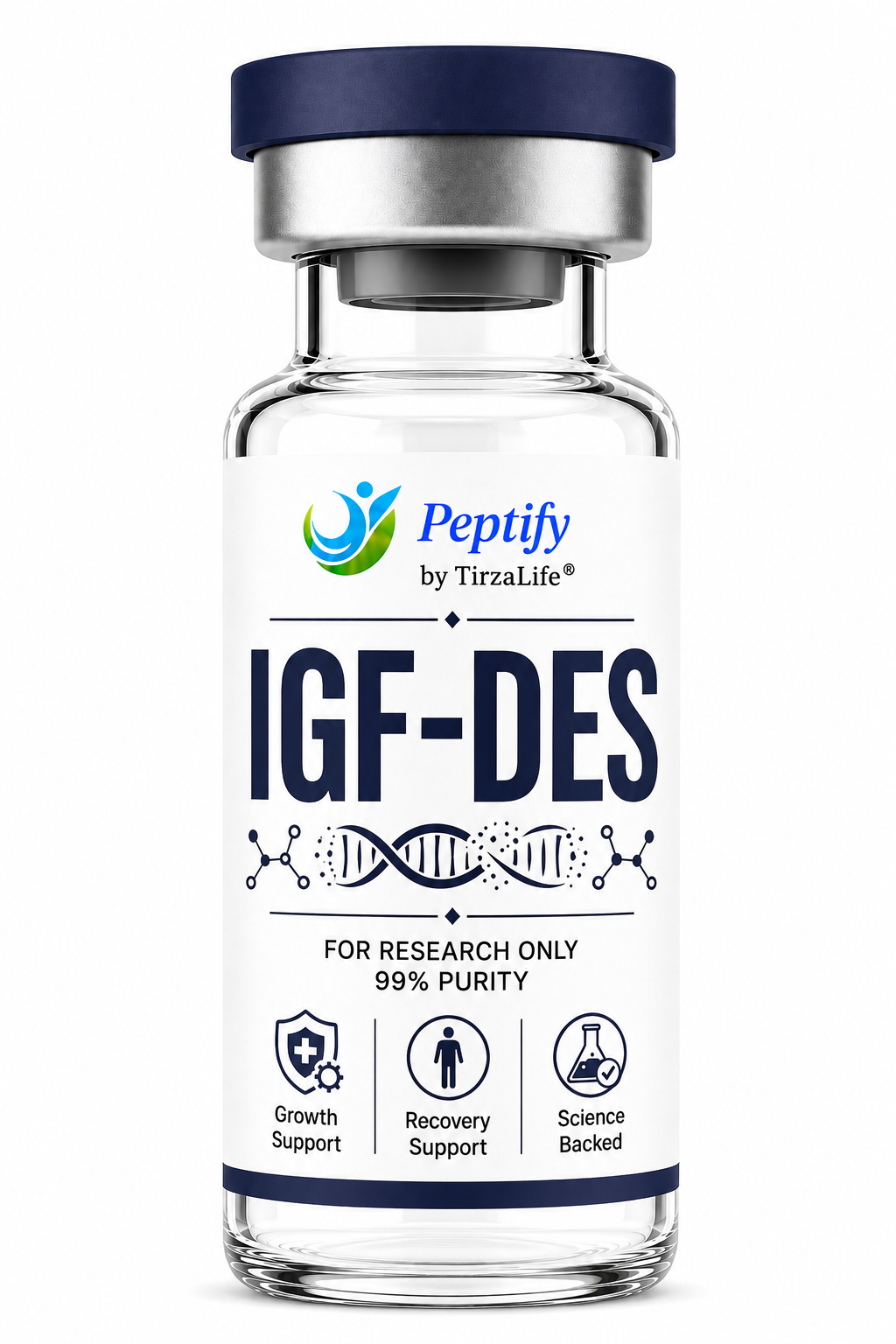
- Product: IGF-DES 2mg vial
- A high-caution growth-factor research entry for IGF signaling and glucose-risk review.
- Source page: Open source
Protocol Overview
IGF-DES is a truncated IGF-1 analog that is generally described as having reduced binding to IGF-binding proteins and strong local IGF receptor activity in research settings. Because it directly engages growth-factor and glucose-related pathways, it should be handled as a high-caution research product requiring clinician review, glucose-risk screening, and no performance or treatment claims.
- IGF signaling research context
- Growth-factor safety review
- Glucose-risk screening
- High-caution clinician discussion
Recommended Source
This protocol is linked to the workbook reference source below.
- IGF-1 DES Dosing Protocols and Administration | Peptide Protocol Wiki Open source
Dosing & Reconstitution Guide
Localized muscle growth and repair via potent IGF-1 receptor activation (research only)
- Amount
- 20-100 mcg per injection (typically 50 mcg bilaterally into target muscles)
- Frequency
- Pre- or post-workout only; training days only
- Duration
- 4 weeks on, 2-4 weeks off
- Route
- Schedule
- Timing
- Immediately post-workout (within 10-15 minutes) or 15-30 minutes pre-workout
- Rest Period
- 4 weeks off between cycles
- Repeatable
- Yes
- Diluent: Bacteriostatic water
- Use within: Use immediately after reconstitution
- Storage: Lyophilized powder: store at -20C or below, stable for months. Reconstituted solution: store at 4C for short-term use (up to 1 week) or aliquot and store at -20C to -80C for longer storage. Avoid repeated freeze-thaw cycles.
- IGF-1
- When: Baseline
- Why: Baseline growth factor levels
- Fasting glucose and fasting insulin
- Why: IGF-1 DES can cause acute hypoglycemia
- HbA1c
- Why: Baseline glycemic marker
- Fasting glucose
- When: Weekly during first 2 weeks
- Why: Monitor for hypoglycemia risk
- When: 2-3 weeks
- Why: Assess impact on systemic IGF-1 levels
- Blood glucose
- When: Ongoing
- Why: Acute hypoglycemia risk (glucose <70 mg/dL); keep fast-acting carbs available
- ⚠️ Acute hypoglycemia risk (glucose <70 mg/dL); keep fast-acting carbs available
- →Extremely short half-life (~5 minutes) makes it site-specific when injected locally
- →Must be used immediately after reconstitution due to rapid degradation
- →Localized IM injection into trained muscles is preferred to maximize site-specific effects
- →Hypoglycemia is a real and dangerous risk; always have fast-acting carbohydrates available
- →Contraindication: Avoid in active or history of cancer; contraindicated in hypoglycemia-prone individuals or those on insulin/sulfonylureas
Dosing Protocol
Free access to research-backed dosing information for all peptides.
| Purpose | Dose | Frequency | Duration | Notes |
|---|---|---|---|---|
| Cell culture - proliferation assays | 1-100 ng/mL in culture medium | Added at medium change or as single pulse | 24-72 hours per experiment | Typical EC50 for proliferation in responsive cell lines is 1-10 ng/mL, approximately 10-fold lower than native IGF-1. |
| Cell culture - differentiation studies | 10-100 ng/mL in culture medium | Added at medium changes throughout differentiation period | Variable, typically 5-14 days for myogenic differentiation | Higher concentrations often used for differentiation protocols. Replaced at each medium change due to degradation in conditioned media. |
| Preclinical research - local administration (animal models) | Research use only - doses vary by study design | Variable by protocol | Variable by study objectives | No standardized in vivo dosing protocols exist. Published animal studies have used a wide range of doses and routes. Not for human use. |
- 150+ peptide profiles · 30+ comparisons · 18 research tools
- Free access to complete dosing tables and protocol details.
- Reconstitute lyophilized IGF-1 DES in sterile water, 0.1M acetic acid, or PBS at pH 7.4. Typical stock concentrations of 100-1000 micrograms/mL. Avoid repeated freeze-thaw cycles. Aliquot upon reconstitution.
- Lyophilized powder: store at -20C or below, stable for months. Reconstituted solution: store at 4C for short-term use (up to 1 week) or aliquot and store at -20C to -80C for longer storage. Avoid repeated freeze-thaw cycles.
- Compare these clinical doses with what 50+ community members report using.
- Based on 50+ community reports
- Review safety warnings and contraindications before starting any protocol.
Important Note
This page is informational and does not authorize use. Peptify clients should complete assessment, disclose medications and health history, and follow the clinician-approved plan only.
| Form | Temperature | Expected Stability | Notes |
|---|---|---|---|
| Lyophilized powder | -20 to -80 degrees C | Months to years | Protect from moisture; desiccate |
| Reconstituted stock | 4 degrees C | Up to 1 week | Short-term working stock only |
| Reconstituted aliquots | -20 to -80 degrees C | Weeks to months | Single-use aliquots preferred |
| In culture medium | 37 degrees C | Hours | Degrades in conditioned media; replenish at medium changes |
- Do not start, stop, combine, or change a protocol based only on website content.
- Emergency symptoms require urgent medical care, not a website or routine follow-up message.
How This Works
Research protocols for IGF-1 DES typically use 1-100 ng/mL in culture medium administered Added at medium change or as single pulse for 24-72 hours per experiment. Typical EC50 for proliferation in responsive cell lines is 1-10 ng/mL, approximately 10-fold lower than native IGF-1.. Alternative protocols may use different doses depending on the research objective. No FDA-approved human dosing exists.
- IGF-1 DES is typically administered via intramuscular injection. Immediately post-workout (within 10-15 minutes) or 15-30 minutes pre-workout. Always follow established research protocols.
- Reconstitute lyophilized IGF-1 DES in sterile water, 0.1M acetic acid, or PBS at pH 7.4. Typical stock concentrations of 100-1000 micrograms/mL. Avoid repeated freeze-thaw cycles. Aliquot upon reconstitution.
- Lyophilized powder: store at -20C or below, stable for months. Reconstituted solution: store at 4C for short-term use (up to 1 week) or aliquot and store at -20C to -80C for longer storage. Avoid repeated freeze-thaw cycles.
- Typical research protocols for IGF-1 DES use a cycle duration of 4 weeks on, 2-4 weeks off. An off-period of 4 weeks is sometimes incorporated between cycles. Cycles may be repeated based on research objectives.
- Pre-filled reconstitution and dose math for IGF-1 DES
- Plan multi-peptide calendars with vial tracking
References
Reference source used for this protocol page.
- IGF-1 DES Dosing Protocols and Administration | Peptide Protocol Wiki Open source
- Peptify Reconstitution Guide