
Hexarelin Acetate 2mg
A research-use GH-secretagogue entry for ghrelin-receptor context and endocrine safety review.
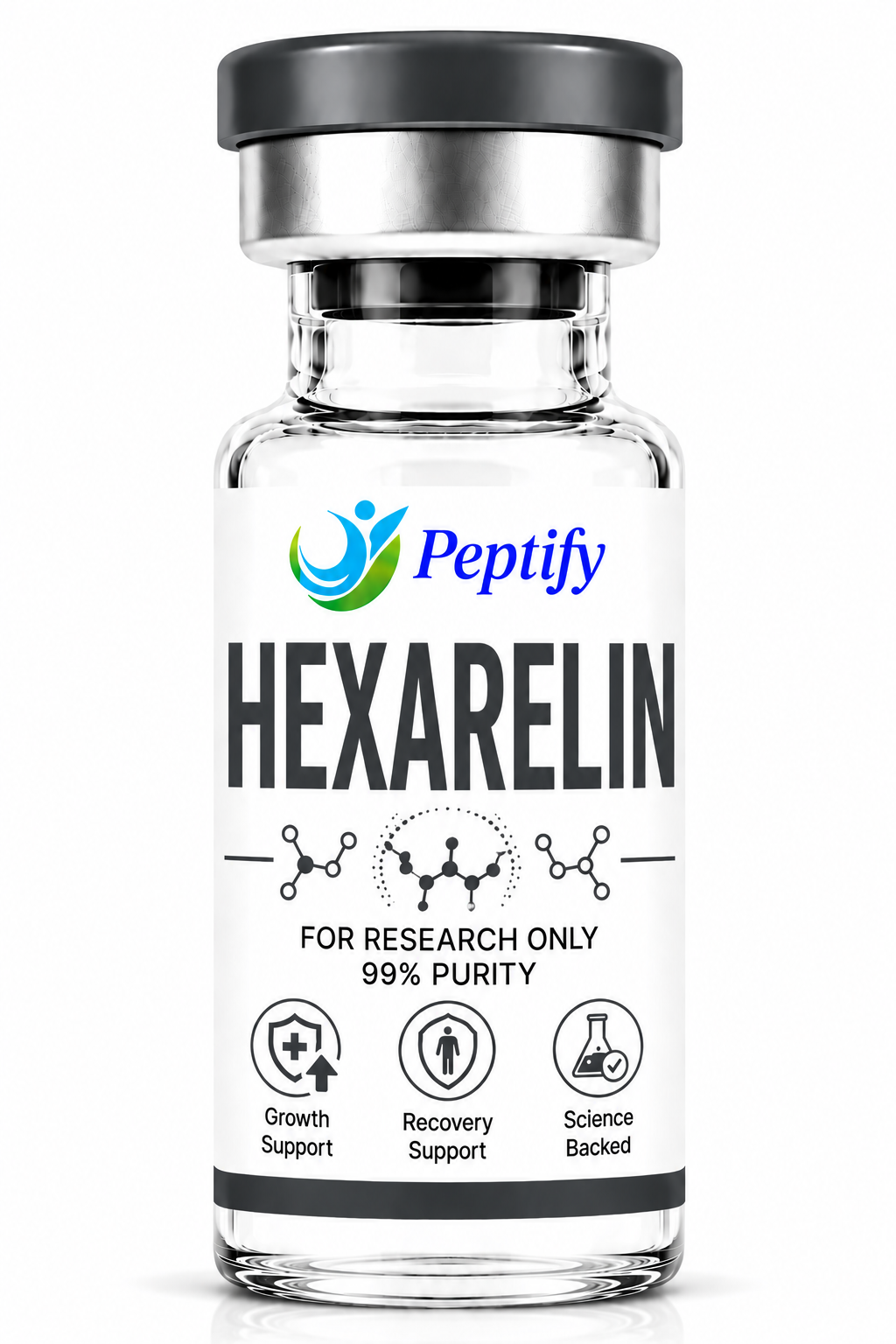
Contents
Use this guide as a structured review page. The same headings appear for every protocol so clients and the care team can scan the page consistently.
Protocol Overview
Hexarelin acetate is a synthetic growth-hormone secretagogue that activates the ghrelin receptor and is studied for GH release and endocrine effects. Compared with some newer secretagogues, it may have stronger prolactin, cortisol, appetite, glucose, and cardiovascular considerations, so review should include endocrine history, labs, medications, and clinician monitoring.
- GH-secretagogue research context
- Ghrelin-receptor pathway review
- Endocrine and cardiovascular screening
- Clinician-guided monitoring discussion
Recommended Source
This protocol is linked to the workbook reference source below.
- Hexarelin Dosage Guide: Protocols & Research | PeptideWiki Open source
Important Note
This page is informational and does not authorize use. Peptify clients should complete assessment, disclose medications and health history, and follow the clinician-approved plan only.
- Do not start, stop, combine, or change a protocol based only on website content.
- Emergency symptoms require urgent medical care, not a website or routine follow-up message.
How This Works
Hexarelin (Examorelin) is a synthetic hexapeptide growth hormone releasing peptide (GHRP) and the most potent member of the GHRP family. It produces the largest growth hormone pulse of any GHRP — significantly greater than GHRP-2, GHRP-6, or Ipamorelin on a microgram-per-microgram basis. Its amino acid sequence is His-D-2-methyl-Trp-Ala-Trp-D-Phe-Lys-NH2.
- What makes Hexarelin unique among GHRPs is its dual mechanism of action. Like all GHRPs, it activates the GHS-R1a (ghrelin) receptor on pituitary somatotrophs to trigger GH release. But Hexarelin also binds to CD36 scavenger receptors on cardiac tissue — a mechanism completely independent of GH. This CD36 activation reduces cardiac fibrosis, protects against ischemia-reperfusion injury, and improves left ventricular ejection fraction (LVEF) in animal models. No other GHRP has demonstrated this cardioprotective effect.
- The trade-off for Hexarelin's potency is the highest desensitization risk of any GHRP. Continuous daily use beyond 4–8 weeks progressively blunts the GH response as GHS-R1a receptors downregulate. This makes cycling mandatory — not optional. This guide covers dosing protocols, desensitization management, stacking with CJC-1295, CD36 cardioprotection, and safety considerations.
- Use our Peptide Dosage to calculate your exact dose based on vial size and concentration.
- Most potent GHRP — produces the largest GH pulse of any growth hormone releasing peptide in head-to-head comparisons
- Hexapeptide — 6 amino acids: His-D-2-methyl-Trp-Ala-Trp-D-Phe-Lys-NH2
- Dual mechanism — GHS-R1a receptor activation (GH release) + CD36 scavenger receptor binding (cardioprotection) — unique among GHRPs
- CD36 cardioprotection — reduces cardiac fibrosis, protects against ischemia-reperfusion injury, improves LVEF in animal models
- Highest desensitization risk — mandatory cycling (4–8 weeks on, equal time off) required to maintain GH response
- Half-life ~70 minutes — GH peak occurs 15–30 minutes post-injection; space multiple daily injections at least 3 hours apart
- For a complete overview of its mechanism and research, see our full Hexarelin profile. New to peptides? Start with the Beginner's Guide to Peptides.
Dosing & Reconstitution Guide
Hexarelin dosing is better supported by human clinical data than most research peptides. Multiple studies by Arvat, Ghigo, and colleagues have established dose-response relationships in healthy volunteers. The commonly used 100–200 mcg range is derived directly from these clinical findings, supplemented by community experience.
| Bac Water Added | Concentration | 100 mcg Dose | 200 mcg Dose |
|---|---|---|---|
| 1 mL | 5,000 mcg/mL | 2 units (0.02 mL) | 4 units (0.04 mL) |
| 2 mL | 2,500 mcg/mL | 4 units (0.04 mL) | 8 units (0.08 mL) |
| 2.5 mL | 2,000 mcg/mL | 5 units (0.05 mL) | 10 units (0.1 mL) |
| 5 mL | 1,000 mcg/mL | 10 units (0.1 mL) | 20 units (0.2 mL) |
- Arvat et al. demonstrated a clear dose-response relationship for Hexarelin in healthy adults, with GH output increasing from 1 mcg/kg through 2 mcg/kg. At doses above approximately 2 mcg/kg (roughly 150–200 mcg for an average adult), GH release plateaus — higher doses do not produce proportionally greater GH but do increase cortisol and prolactin elevation. This ceiling effect is the basis for the 200 mcg maximum per injection.
- Broglio et al. and Ghigo et al. documented progressive attenuation of the GH response with continuous Hexarelin administration. After 4–8 weeks of daily dosing, the GH pulse was significantly reduced compared to baseline — confirming the need for cycling. Receptor downregulation appears dose-dependent: higher daily doses and more frequent injections accelerate desensitization.
- Muccioli et al. identified Hexarelin's binding to CD36 scavenger receptors on cardiac tissue — an effect independent of GH release and unique to Hexarelin among GHRPs. This research demonstrated cardioprotective effects including reduced cardiac fibrosis and protection against ischemia-reperfusion injury. The CD36 effect occurs at standard dosing ranges and does not require higher doses.
- Enter your vial size, water volume, and desired dose — get instant calculations with zero manual math.
Dosing Protocol
Hexarelin is administered by subcutaneous injection on an empty stomach. The dose-response ceiling at 200 mcg per injection is well-established — exceeding this does not increase GH output but does increase side effects. All injections should be performed fasted (at least 2 hours after eating, 30–45 minutes before eating).
| Protocol | On-Cycle | Off-Cycle | Notes |
|---|---|---|---|
| Conservative | 4 weeks | 4 weeks off | Lowest desensitization risk; best for first-time users |
| Standard | 6 weeks | 6 weeks off | Most common protocol; balances effectiveness with receptor recovery |
| Maximum | 8 weeks | 8 weeks off | Upper limit; some GH blunting may occur in weeks 6–8 |
| Rotation Strategy | 4–6 weeks Hexarelin | 4–6 weeks Ipamorelin | Year-round GH support; Ipamorelin during off-cycle maintains GH without further desensitization |
- Always fasted: Inject at least 2 hours after eating and 30–45 minutes before eating
- Space injections 3+ hours apart: The pituitary needs time to replenish GH stores between pulses
- Optimal timing (2x daily): Morning upon waking (fasted) + before bed (fasted 2–3 hours)
- Optimal timing (3x daily): Morning + mid-afternoon + before bed — all fasted windows
- These vendors are vetted by PeptideWiki for purity testing and COA transparency.
- Not all GHRPs are equal. They share the same GHS-R1a receptor but differ significantly in GH potency, side effect profiles, and desensitization risk. This table compares the four most commonly used GHRPs across key parameters.
- Hexarelin is supplied as a lyophilized (freeze-dried) powder, typically in 2 mg or 5 mg vials. You reconstitute it with bacteriostatic water, then draw your dose using an insulin syringe. The concentration depends on how much water you add to the vial.
- Vial size: 5 mg (5,000 mcg) of Hexarelin
- Bacteriostatic water added: 2.5 mL
- Concentration: 5,000 mcg ÷ 2.5 mL = 2,000 mcg per mL
- Target dose: 200 mcg
- Volume to draw: 200 ÷ 2,000 = 0.1 mL = 10 units on an insulin syringe
- Hexarelin's dual mechanism (GH release + CD36 cardioprotection) makes it applicable to multiple goals. The optimal protocol varies depending on whether you are targeting maximum GH output, body composition, cardiac benefits, or general recovery.
- For users seeking the largest possible GH pulse to support muscle protein synthesis, recovery, and anabolic signaling. Best combined with a GHRH analog for synergistic output. This is the most aggressive protocol and carries the highest desensitization risk.
- Dose: 200 mcg per injection (SubQ)
- Frequency: 2–3x daily, all fasted
- Cycle: 4–6 weeks on, 4–6 weeks off (mandatory)
- Stack: + CJC-1295 (no-DAC) 100 mcg at each injection for 3–5x synergistic GH output
- GH elevation promotes lipolysis (fat breakdown) and improves body composition over time. Hexarelin's potent GH pulse makes it effective for fat loss protocols, though results develop over weeks. Moderate dosing reduces side effects while maintaining meaningful GH elevation.
- Dose: 100–200 mcg per injection (SubQ)
- Frequency: 2x daily (morning fasted + before bed fasted)
- Cycle: 6–8 weeks on, 6–8 weeks off
- Note: The before-bed injection synergizes with the natural nocturnal GH pulse for enhanced overnight fat oxidation
- For users primarily interested in Hexarelin's unique CD36-mediated cardiac benefits — reduced fibrosis, ischemia-reperfusion protection, and improved LVEF. The CD36 effect occurs at standard doses and does not require maximum GH protocols. A lower, more sustainable approach is appropriate.
- Frequency: 1–2x daily
- Cycle: 4–8 weeks on, equal time off
- Note: CD36 binding occurs at standard dosing; no need to push to maximum GH doses for cardiac benefit
- Conservative dosing for users seeking improved sleep quality, faster recovery from training, skin quality, and general anti-aging benefits associated with optimized GH levels. Lower doses reduce desensitization risk and side effects.
- Dose: 100 mcg per injection (SubQ)
- Frequency: 1–2x daily (before bed is ideal)
- Alternative: Consider Ipamorelin for year-round use if desensitization management is a concern
- Desensitization is the single most important consideration when using Hexarelin. Continuous daily stimulation of the GHS-R1a receptor causes progressive downregulation, reducing the GH pulse over time. This is not a minor concern — it is the primary limitation of Hexarelin and the reason it must be cycled.
- The most popular year-round strategy for GHRP users who want sustained GH support. Run Hexarelin for 4–6 weeks for maximum GH potency and CD36 cardioprotection, then switch to Ipamorelin for 4–6 weeks while GHS-R1a receptors recover. Ipamorelin's minimal desensitization risk makes it safe for the off-cycle period. This rotation provides continuous GH elevation without the receptor downregulation that would occur with non-stop Hexarelin use.
- Reduced GH-related effects compared to the first weeks of the cycle (less pronounced sleep improvement, recovery, or body composition changes)
- Diminishing “flush” or warmth sensation post-injection (if previously experienced)
- Reduced appetite response compared to early in the cycle
- If IGF-1 blood work is available: declining IGF-1 levels despite consistent dosing
Lifestyle Factors
Hexarelin stacking follows one fundamental rule: pair with a GHRH analog, never with another GHRP. GHRPs and GHRHs work through different mechanisms that synergize powerfully, while stacking multiple GHRPs is redundant (they compete for the same receptor) and accelerates desensitization.
| Compound | Dose | Frequency | Purpose |
|---|---|---|---|
| Hexarelin | 100–200 mcg SubQ | 1–2x daily (fasted) | GH pulse trigger + CD36 cardioprotection |
| Sermorelin | 200–300 mcg SubQ | At each Hexarelin injection | GHRH receptor agonist; amplifies GH pulse naturally |
- The most effective Hexarelin stack. Hexarelin triggers the GH pulse via GHS-R1a, while CJC-1295 (a GHRH analog) amplifies and sustains it via the GHRH receptor. Together they produce 3–5 times the GH output of either peptide alone. This is the single most impactful addition to any Hexarelin protocol.
- Combines Hexarelin's systemic GH elevation with BPC-157's localized tissue repair for injury recovery protocols. Hexarelin supports recovery through elevated GH and IGF-1, while BPC-157 provides direct angiogenesis and growth factor upregulation at the injury site.
- The most practical approach for sustained GH support across the calendar year. Alternate between Hexarelin (maximum potency, CD36 benefits) and Ipamorelin (clean profile, no desensitization) in equal-length cycles. This provides continuous GH elevation without the receptor downregulation that would occur with non-stop Hexarelin.
- An alternative to CJC-1295 for users who prefer a more natural GHRH analog. Sermorelin is a 29-amino-acid GHRH analog that stimulates pituitary GH release through the GHRH receptor, synergizing with Hexarelin's GHS-R1a mechanism. Sermorelin has a shorter half-life than CJC-1295 and produces a more physiological GH pattern.
- Explore more combinations with our Peptide Stack Builder or browse the Top 10 Peptide Stacks guide.
Potential Benefits & Side Effects
Dose-dependent and generally manageable:
- Cortisol elevation — more pronounced than other GHRPs; may affect sleep, mood, or body fat distribution at higher doses
- Prolactin elevation — may cause breast tenderness, low libido, or mood changes in sensitive individuals
- Moderate appetite increase — less intense than GHRP-6 but more than Ipamorelin
- Water retention and bloating — common with GH elevation, usually mild and transient
- Injection site redness, soreness, or minor swelling
- Numbness or tingling in extremities — related to GH effects on fluid balance
- Less common:
- Headache — usually in the first few days, resolves with continued use
- Flushing or warmth sensation post-injection — generally harmless
- Fatigue or lethargy — may indicate cortisol dysregulation at high doses
- Active cancer or history of cancer — GH elevation promotes cell proliferation. Elevated GH and IGF-1 could theoretically support tumor growth. Avoid use with active malignancies.
- Pregnancy and breastfeeding — no safety data exists for Hexarelin during pregnancy or nursing. Avoid entirely.
- Pituitary disorders — Hexarelin acts directly on pituitary somatotrophs. Pre-existing pituitary tumors or dysfunction are contraindications.
- Uncontrolled diabetes — GH elevation can worsen insulin resistance and blood glucose control. Use with medical supervision only in diabetic patients.
- Hyperprolactinemia — Hexarelin elevates prolactin more than other GHRPs. Pre-existing elevated prolactin is a contraindication.
- Signs of elevated prolactin (breast tenderness, gynecomastia, low libido, menstrual irregularity)
- Signs of elevated cortisol (disrupted sleep, increased anxiety, unexplained weight gain, especially abdominal)
- Significant water retention or persistent bloating that does not resolve
- Suspected desensitization (diminishing effects despite consistent dosing) — end the cycle early
- Any symptom that feels unusual or concerning — err on the side of caution
- Avoid these common errors to get the most out of your Hexarelin protocol:
Quickstart Highlights
This article is for educational and informational purposes only. See our Disclaimer.
- Hexarelin is the most potent GHRP — it produces the largest GH pulse of any growth hormone releasing peptide
- Standard dose: 100–200 mcg SubQ, 1–3x daily fasted — do not exceed 200 mcg per injection (dose-response ceiling)
- Unique CD36 cardioprotection — Hexarelin is the only GHRP that binds CD36 scavenger receptors, reducing cardiac fibrosis and protecting against ischemia-reperfusion injury
- Cycling is mandatory: 4–8 weeks on, equal time off. Hexarelin has the highest desensitization risk of any GHRP
- Gold standard stack: Hexarelin + CJC-1295 for 3–5x synergistic GH output through complementary GHRP + GHRH mechanisms
- Never stack with other GHRPs — they compete for the same receptor. Rotate between GHRPs instead (Hexarelin on-cycle, Ipamorelin off-cycle)
- Cortisol and prolactin elevation are more pronounced than with other GHRPs — monitor for symptoms and reduce dose if needed
- Always inject fasted — food blunts the GH response. Wait at least 2 hours after eating and 30–45 minutes before eating
- Space injections 3+ hours apart to allow pituitary GH stores to replenish between pulses
- Not FDA-approved — classified as a research peptide. Banned by WADA for competitive athletes. Check local regulations.
References
Continue your research with these resources.
- Hexarelin Dosage Guide: Protocols & Research | PeptideWiki Open source
- Arvat E, et al. “Endocrine activities of ghrelin, a natural growth hormone secretagogue (GHS), in humans: comparison and interactions with hexarelin, a nonnatural peptidyl GHS, and GH-releasing hormone.” J Clin Endocrinol Metab. 2001;86(3):1169-1174. PubMed Open source
- Broglio F, et al. “Endocrine and non-endocrine actions of ghrelin.” Horm Res. 2003;59(3):109-117. PubMed Open source
- Muccioli G, et al. “Growth hormone-releasing peptides and the cardiovascular system.” Ann Endocrinol (Paris). 2000;61(1):27-31. PubMed Open source
- Ghigo E, et al. “Growth hormone-releasing peptide-6 and hexarelin as diagnostic and therapeutic agents.” Horm Res. 1999;51 Suppl 3:59-63.
- Rahim A, et al. “Acute administration of hexarelin, a synthetic growth-hormone-releasing peptide, in healthy elderly subjects.” Clin Endocrinol (Oxf). 1998;49(4):487-492.
- Mao Y, et al. “Hexarelin treatment preserves myocardial function and reduces cardiac fibrogenesis in diabetic rats.” Mol Cell Endocrinol. 2014;382(1):264-274.
- Locatelli V, et al. “Growth hormone-releasing peptides and their analogs.” Front Neuroendocrinol. 1999;20(1):47-72.
- Muccioli G, et al. “Hexarelin binds to cardiac and skeletal muscle receptors.” Endocrinology. 1998;139(9):4093-4097.
- Arvat E, et al. “Preliminary evidence for an anti-aging effect of hexarelin in elderly subjects.” Growth Horm IGF Res. 1998;8 Suppl B:77-81.
- Learn dosing protocols for Ipamorelin — the ideal off-cycle GHRP for year-round rotation with Hexarelin.
- Calculate your exact Hexarelin dose based on vial size and reconstitution volume.
- Browse all peptides with research summaries and dosing data.
- Take the complete Hexarelin Dosage Guide with you. All sections, dosing tables, and FAQ — formatted for easy reference.
- Free. No spam. Unsubscribe anytime.
- Community-driven knowledge base for research peptides. Evidence-based profiles, dosing guides, and practical tools.
- Peptide Directory
- Browse by Goal
- Peptide Glossary
- Guides
- Stack Guides
- Deals
- Dosage Calculator
- Stack Builder
- Peptide Quiz
- Protocol Tracker
- Cheat Sheet
- Blog
- News & Media
- Scientific Research
- Community
- About PeptideWiki
- Editorial Standards
- Community Guidelines
- Affiliate Disclosure