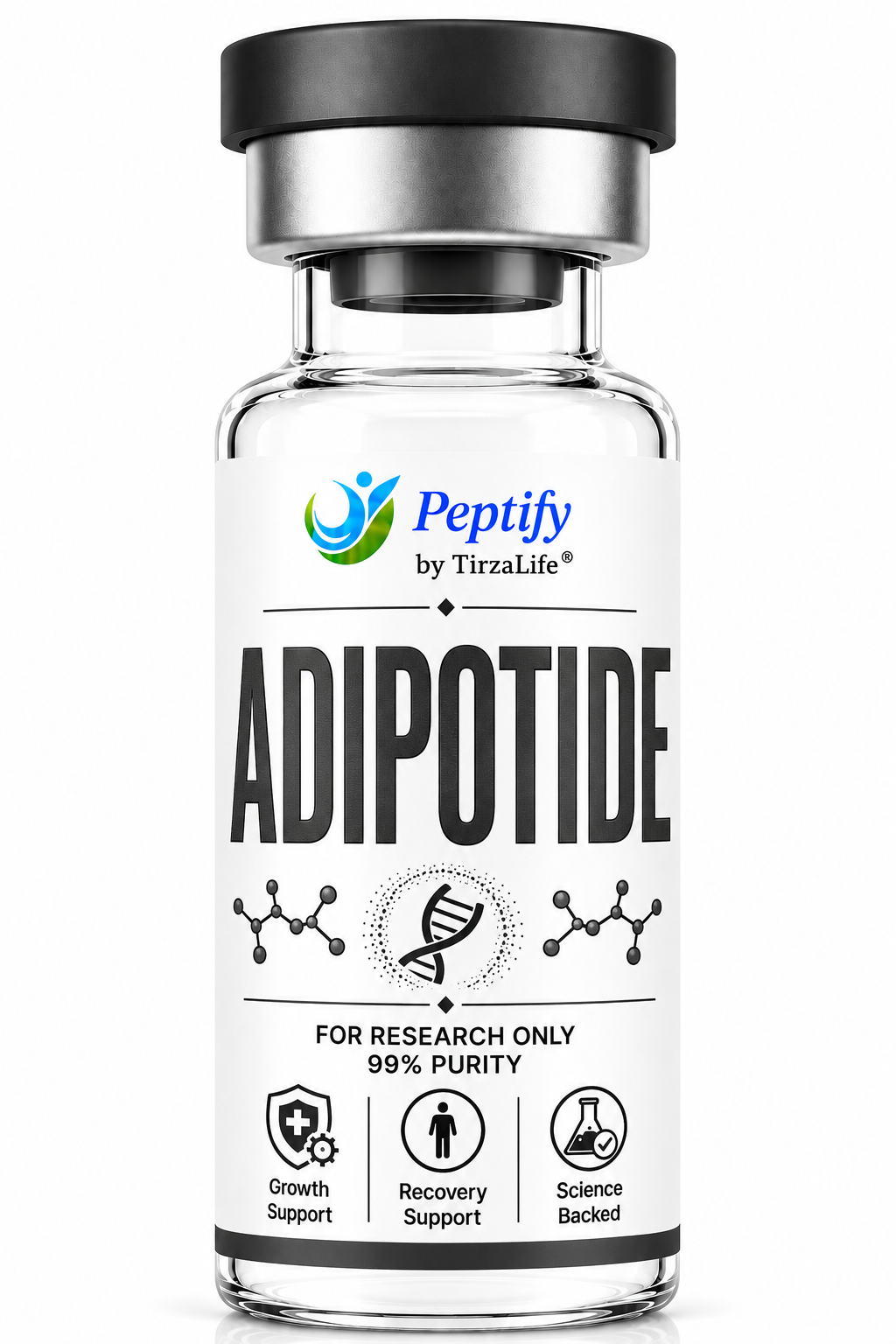
Adipotide/FTTP 10mg
A high-caution metabolic research peptide entry for adipose-vasculature literature and safety review.
Contents
Use this guide as a structured review page. The same headings appear for every protocol so clients and the care team can scan the page consistently.
Quickstart Highlights
Reference-linked protocol details for Adipotide/FTTP 10mg.
- Reference title: Adipotide Dosage Calculator and Chart | A-Z Guide
- Product: Adipotide/FTTP 10mg vial
- A high-caution metabolic research peptide entry for adipose-vasculature literature and safety review.
- Source page: Open source
Protocol Overview
Adipotide, also described in research contexts as a fat-targeted pro-apoptotic peptidomimetic, is studied in preclinical models for targeting blood vessels supplying white adipose tissue. Published animal work raised kidney-related toxicity concerns, so this 10mg entry should remain high-caution research context only with no human wellness or weight-loss claims.
- Adipose-vasculature research context
- Preclinical safety-signal review
- Kidney and metabolic risk discussion
- High-caution clinician review
Recommended Source
This protocol is linked to the workbook reference source below.
- Adipotide Dosage Calculator and Chart | A-Z Guide Open source
Important Note
This page is informational and does not authorize use. Peptify clients should complete assessment, disclose medications and health history, and follow the clinician-approved plan only.
- Do not start, stop, combine, or change a protocol based only on website content.
- Emergency symptoms require urgent medical care, not a website or routine follow-up message.
How This Works
Adipotide is an experimental peptide that has been studied for its potential to induce weight loss and improve glucose tolerance in research subjects [1, 2]. In the literature, it is often referred to as “prohibitin-targeting peptide 1” (prohibitin-TP01) and “Fat Targeted Proapoptotic Peptide” (FTPP).
- Researchers have observed adipotide to systemically target the endothelium of fat through a ligand-directed mechanism, thereby reducing the blood supply of white adipose tissue—the predominant fat found in the human body. Seminal adipotide research in obese primates and rodents has reported adipotide’s ability to reverse high-fat diet-induced obesity through this targeted induction of apoptosis mechanism [1].
- In May 2012, researchers started a Phase I dose-finding trial of adipotide in patients with metastatic prostate cancer and obesity, all for whom standard treatment options were not an option. That trial was discontinued in January 2019 for unspecified reasons, with no reports of clinical development thereafter [2].
- Adipotide is available online as a research chemical and may be legally purchased by licensed researchers and laboratory professionals for laboratory experimentation only.
- The global obesity pandemic is in full swing, with worldwide prevalence having tripled since 1975. For example, the World Health Organization (WHO) estimated in 2022 that 60% of Europeans are either overweight or obese [3].
- Adipotide is seen as a promising weight loss agent to help combat this pandemic. It is a vascular-targeted drug that has shown rapid weight loss in animals through its triggering of the apoptosis of adipose endothelial cells [4].
- Research into the benefits of adipotide is still in its infancy, and as stated above, clinical development of the drug has been discontinued for unspecified reasons. Nevertheless, here is a summary of what we do know about adipotide so far:
- Kolonin et al. (2004) demonstrated that adipotide interacts with prohibitin 1 in the adipose vasculature of mice to trigger the ablation of white fat. The researchers observed a ~30% weight reduction in the rodent subjects over a four-week period following adipotide administration [5]. Open source
- Kim et al. (2010) investigated the effects of adipotide in high fat diet-induced obese rodents over a period of 27 days, reporting that the peptide completely reversed the obesity and reduced the body weight of the rodents. The team found that the fat loss occurred due to the rodent’s reduced food intake, suggesting that adipotide targets excessive adipose tissue caused by the consumption of a high fat diet [6]. Open source
- Barnhart et al. (2011) oversaw a series of adipotide studies involving three types of Old World monkeys, confirming, inter alia, that the peptide can be used to decrease white adipose tissue via targeted apoptosis within the blood vessels of that tissue. The researchers observed body weight decreases of up to 38.7% in obese, adipotide-treated primates, putting forth adipotide as a candidate drug for the treatment of obesity in human patients [1]. Open source
- Staquicini et al. (2011) identified adipotide as a potential advanced cancer therapy due to its ability to target prohibitin, which is linked to certain types of cancer. Because cancer cells require significant blood supply to grow and metastasize, adipotide’s targeting of prohibitin in those cells without harming surrounding tissue makes it a candidate for further research in this field [7]. Open source
- Kim et al. (2012) posited that chronic white adipose tissue (WAT) inflammation may play a role in causing obesity, and that macrophage recruitment in WAT increases insulin resistance. The team treated high fat diet-induced obese mice with adipotide, demonstrating that the peptide rapidly and potently improved glucose tolerance in the subjects. This supported the researchers’ hypothesis that adipotide administration reverses impaired glucose regulation as a result of impaired WAT function [8]. Open source
- Due to the limited amount of adipotide research conducted to date, researchers have not been able to definitively pronounce on the peptide’s side effects and safety profile.
- As of this date, the Barnhart et al. (2011) research involving three species of Old World primates (rhesus monkeys, baboons, and crab-eating macaques) appears to be the best starting point for researchers looking for information on adipotide side effects. Notably, primates who were treated at an adipotide dose of 0.43mg/kg daily for four weeks [1]:
- Exhibited normal levels of activity without any overt clinical signs of nausea, vomiting, or food aversion
- Showed normal lipid profiles that did not vary throughout the study
- Registered higher levels of serum creatinine from adipotide doses of 0.25mg/kg
- Increased urine, with mild dehydration being reported at the highest adipotide dose levels
- Most changes in the primates’ serum and urine were reversed within 28 days following discontinuation of treatment [1].
- More importantly, toxicology studies in the treated monkeys revealed that the most prominent adverse effects of adipotide were kidney lesions and altered tubular function, albeit with the researchers observing that these were “relatively mild, predictable, and reversible” [1].
- Nevertheless, important kidney function markers to monitor during adipotide research include risks of:
- Decreased serum phosphorus and potassium
- Glucosuria
- Proteinuria
- Increase in transitional/renal epithelial cells
- While researchers at the University of Texas M.D. Anderson Cancer Center commenced a dose-finding and safety study into adipotide in 2012, the human trial was discontinued for unspecified reasons and no safety data was made publicly available [2].
- The scarcity of adipotide research has also prevented experts from determining standardized, safe, and effective adipotide dosage guidelines. However, here is what we can glean from the limited research available:
- While the daily dose of 0.43mg/kg daily was well tolerated in primates in the Barnhart et al. (2011) studies, it is important to note that dosage in primates does not scale to humans [1]. Open source
- In the discontinued dose-finding trial undertaken at the Anderson Cancer Center, the investigators established a starting dose of 0.03mg/kg of body weight, injected subcutaneously once daily for 28 days. It is important to note that this trial involved obese patients with advanced prostate cancer, and the objective of the trial was to determine the highest tolerable dose of adipotide in said group [2]. Open source
- Bearing this information in mind, anecdotal reports suggest that adipotide should be dosed conservatively in research settings, stating that the daily dose should not exceed 0.01mg/kg of bodyweight, which is equal to 4.53 mcg/lb, injected subcutaneously for up to 28 days.
- Based on this data as a reference, here is a sample adipotide dosing protocol for research:
- Daily Dose: 0.01mg/kg of bodyweight.
- Frequency: Once daily in the form of a subcutaneous injection.
- Study Duration: 28 days.
- Notes: Monitor kidney function daily, due to an increased risk of tubular toxicity after the first week of the trial. One 10mg Adipotide vial suffices for 10 days of administration per subject with a body weight of 200lb.
- Since research on adipotide is pending, researchers are well-advised to stay up to date on latest developments for more information.
- Now, we will look at where to safely and securely buy adipotide online for research.
- In our experience, there is no retailer better than Pure Rawz for the online purchase of adipotide for research.
- Here's why:
- PureRawz is a well-recognized vendor that manufactures top-tier products via rigorous quality control measures at all phases of production.
- Let’s explore in detail why PureRawz is a go-to vendor of the global research community:
- Quality is guaranteed and fully verified: To bolster its claim of 99% purity on all peptides, the vendor does first- and third-party lab testing on all products, including research peptides.
- Competitive pricing: The vendor’s manufacturing practices enable it to offer top-quality products at reasonable prices. Adipotide 10mg is currently offered for $87.48.
- Quick shipping: Shipping rates are also competitive with services offered to select international locations. US orders over $100 are shipped free of charge and typically arrive within 4-10 business days.
- Smooth checkout and data protection: Checkout is rapid and easy on the user-friendly website that features the latest SSL-encryption technology for data protection. Payment methods are clearly delineated, and a wide range is accepted including credit cards and PayPal.
- Service is unmatched: PureRawz is committed to researcher satisfaction, and it shows in its service practices. The helpful staff offers rapid responses to questions, and mistaken orders are readily replaced.
- For an unquestionably satisfying peptide purchase, check out this impressive research peptides vendor below:
- Buy Adipotide from our top-rated vendor...
- Adipotide has been shown to accelerate fat loss in laboratory animals by specifically targeting and eliminating fat cells. In addition, adipotide has been used to improve glucose tolerance in preclinical studies, opening the door to its potential use as a treatment of metabolic disorders.
- Safety and dosage data in humans is not available for adipotide as of this writing. Accordingly, researchers are advised to proceed with extreme care when investigating this peptide.
- This includes both sourcing the peptide from a reputable vendor, and following best practices when reconstituting the peptide for injection.
- For licensed researcher looking to obtain adipotide, we recommend buying only from trusted vendor like our top-rated one.
References
Disclaimer: Peptides.org contains information about products that are intended for laboratory and research use only, unless otherwise explicitly stated. This information, including any referenced scientific or clinical research, is made available for educational purposes only. Peptides.org makes every effort to ensure that any information it shares complies with national and international standards for clinical trial information and is committed to the timely disclosure of the design and results of all interventional clinical studies for innovative treatments publicly available or that may be made available. However, research is not considered conclusive. Peptides.org makes no claims that any products referenced can cure, treat or prevent any conditions, including any conditions referenced on its website or in print materials.
- Adipotide Dosage Calculator and Chart | A-Z Guide Open source
- Barnhart KF, Christianson DR, Hanley PW, et al. A peptidomimetic targeting white fat causes weight loss and improved insulin resistance in obese monkeys. Sci Transl Med. 2011;3(108):108ra112. doi:10.1126/scitranslmed.3002621
- National Library of Medicine (U.S.). (2010, December – 2019, January). A First-in-Man, Phase I Evaluation of A Single Cycle of Prohibitin Targeting Peptide 1 in Patients With Metastatic Prostate Cancer and Obesity. Identifier NCT01262664. Open source
- Boutari C, Mantzoros CS. A 2022 update on the epidemiology of obesity and a call to action: as its twin COVID-19 pandemic appears to be receding, the obesity and dysmetabolism pandemic continues to rage on. Metabolism. 2022 Aug;133:155217. doi: 10.1016/j.metabol.2022.155217. Epub 2022 May 15. PMID: 35584732; PMCID: PMC9107388.
- Fang Y, Kaszuba T, Imoukhuede PI. Systems Biology Will Direct Vascular-Targeted Therapy for Obesity. Front Physiol. 2020 Jul 15;11:831. doi: 10.3389/fphys.2020.00831. PMID: 32760294; PMCID: PMC7373796.
- Kolonin MG, Saha PK, Chan L, Pasqualini R, Arap W. Reversal of obesity by targeted ablation of adipose tissue. Nat Med. 2004;10(6):625-632. doi:10.1038/nm1048
- Kim DH, Woods SC, Seeley RJ. Peptide designed to elicit apoptosis in adipose tissue endothelium reduces food intake and body weight. Diabetes. 2010 Apr;59(4):907-15. doi: 10.2337/db09-1141. Epub 2010 Jan 26. PMID: 20103704; PMCID: PMC2844838.
- Staquicini FI, Cardó-Vila M, Kolonin MG, Trepel M, Edwards JK, Nunes DN, Sergeeva A, Efstathiou E, Sun J, Almeida NF, Tu SM, Botz GH, Wallace MJ, O'Connell DJ, Krajewski S, Gershenwald JE, Molldrem JJ, Flamm AL, Koivunen E, Pentz RD, Dias-Neto E, Setubal JC, Cahill DJ, Troncoso P, Do KA, Logothetis CJ, Sidman RL, Pasqualini R, Arap W. Vascular ligand-receptor mapping by direct combinatorial selection in cancer patients. Proc Natl Acad Sci U S A. 2011 Nov 15;108(46):18637-42. doi: 10.1073/pnas.1114503108. Epub 2011 Nov 2. PMID: 22049339; PMCID: PMC3219136.
- Kim DH, Sartor MA, Bain JR, et al. Rapid and weight-independent improvement of glucose tolerance induced by a peptide designed to elicit apoptosis in adipose tissue endothelium. Diabetes. 2012;61(9):2299-2310. doi:10.2337/db11-1579
- Privacy Policy Open source
- Affiliate Disclosure Open source
- Disclaimer Open source
- Medical Disclaimer Open source
- Sitemap Open source
- About Us Open source
- Contact Us Open source
- Work With Us Open source
- Advertise With Us Open source
- Editorial Policy Open source
- To the extent that Peptides.org references a product that is also a prescription medication, Peptides.org does not does not offer medical diagnosis or treatment advice. The contents of Peptides.org are intended exclusively for qualified researchers. Any individual seeking any advice on any prescription medication, or any disease or condition, is advised to refrain from using this site and consult their healthcare provider. Statements regarding products presented on Peptides.org are the opinions of the individuals making them and are not necessarily the same as those of Peptides.org.
- Your access to Peptides.org is subject to our terms of use.
- GDPR Policy Open source
- Modern Slavery Statement Open source
- Cookies Policy Open source
- EDI Policy Open source
- Accessibility Open source
- Code of Ethics Open source
- © Peptides.org. All rights reserved.